2024 UPDATE: Here's another video commemorating Mooresville's bicentennial.
Mooresville Moments 30, by Mooresville Public Library
Mooresville, Indiana Bicentennial (1824-2024)
Mooresville, Indiana celebrates the bicentennial of its founding in 2024 (having been established in 1824 by Samuel Moore), and Mooresville Public Library has a promo trailer for the event. Click the video (below) to watch.
Mooresville (Indiana) Bicentennial Promo Trailer,
by Mooresville Public Library
There are also a couple of books (just published in January, 2023) celebrating the town's bicentennial:
A children's book written by Cauli Le Chat, MPL feline roving reporter (digitized version available below; print copy available for checkout at Mooresville Public Library; paperback and Kindle editions available to buy from Amazon);
A grown-up's book written by some author you've never heard of (digitized version available below; print copy available for checkout at Mooresville Public Library)
Watch our book trailers (below) to learn more about these two books. (Click the boxes below to play videos.)
MPL Book Trailer #865
MPL Book Trailer #869
The Mooresville200 group is planning a big bicentennial celebration during 2024. It should be great fun! The library created a couple of promo trailers for Mooresville200 (click players below to watch the videos).
Mooresville200 Promo Trailer 1, by Mooresville Public Library
Mooresville200 Promo Trailer 2, by Mooresville Public Library
Those familiar with the history of Mooresville Public Library (MPL) know that construction of the "new" library building began in June, 1987. The library is fortunate to have a VHS videotape recording made in May/June 1987 by Noel Plunkett, which shows the "old" library Carnegie building located at 32 West Main Street in downtown Mooresville, Indiana, as well as the construction site for the "new" library, which I call the 1988 building.
What good is a VHS cassette, you may well ask. Who has videocassette recorders (VCRs) anymore? Thankfully, there are wonderful gadgets that can convert videotapes into DVDs or digital recordings, and the library has such a gizmo. Yesterday, I converted the videotape to DVD and digital formats. Then, I took the raw video/audio and made a quick edit using Wondershare Filmora software. Here's the result:
Mooresville Public Library, May/June 1987 Video, by Noel Plunkett
(Click Above to Play Video)
Mr. Plunkett's video begins by showing the front exterior of the MPL Carnegie building, then moves to selected interior shots. Three MPL employees were captured on videotape: MPL Director Sharon Beatrice, MPL Assistant Director/Indiana Room Librarian Wanda Potts, and MPL Staffer Mattie Deaton. Then, Mr. Plunkett moves a few blocks west to 220 West Harrison Street, where construction began (in June, 1987) on the 1988 building. Several unidentified construction workers appear in the video. Mr. Plunkett provides a couple of voice-overs during the recording, in which he states the date of videography at the construction site.
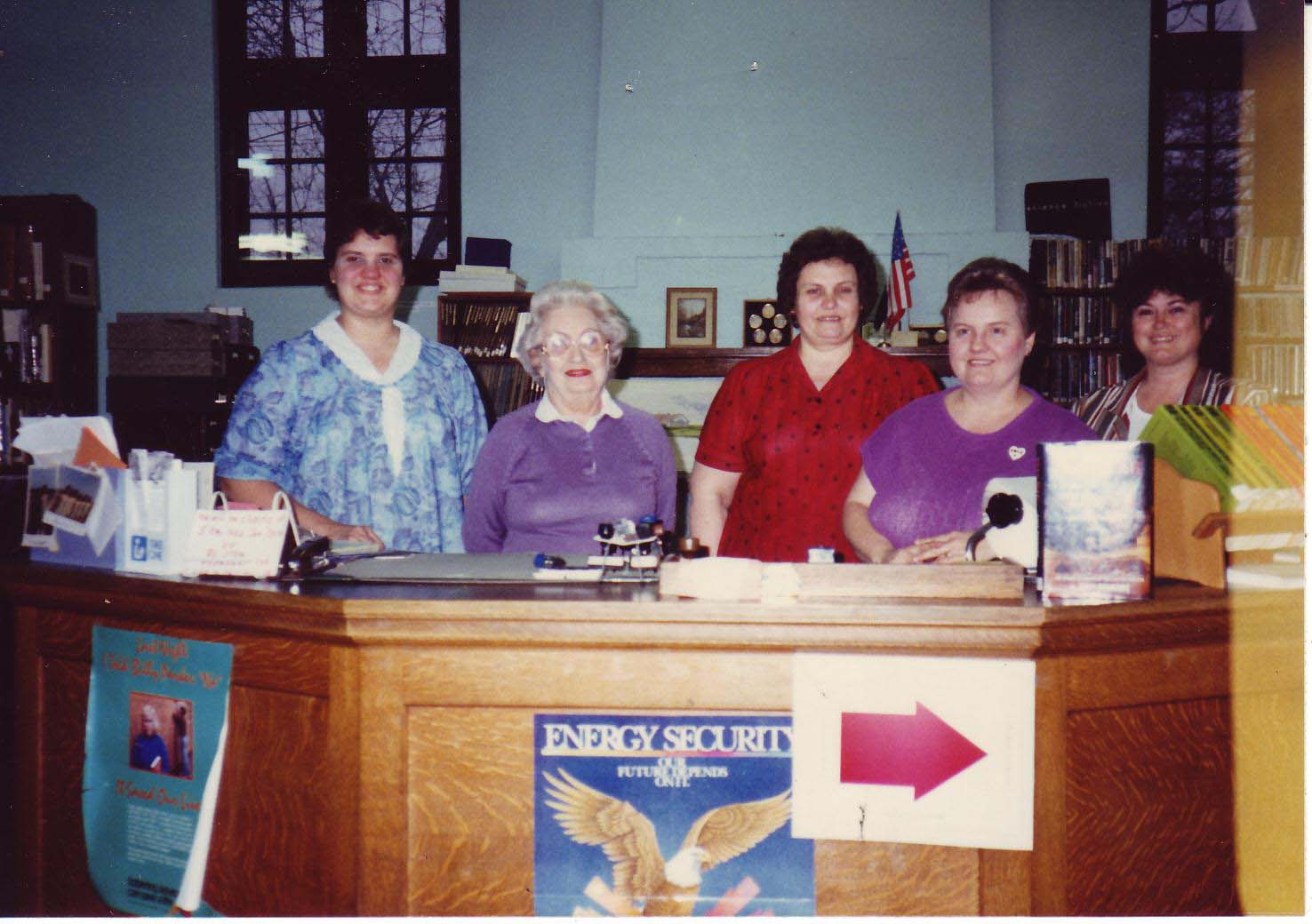
Wanda Potts & Mattie Deaton appeared in this photo
of MPL Carnegie's last day (January, 1988)
L to R: Director Pat Vahey, Asst. Dir. Wanda Potts,
Staffers Mattie Deaton, Theresa Lucas, and Sandy Lefler
MPL Director Sharon Beatrice (1984-1987)
Indianapolis News, Monday, June 15, 1987
The original video quality was low-resolution, and the audio was captured by a condenser microphone on the camera, so it is difficult to hear. Retail camcorders from the mid-1980s filmed in analog, so the recording appears fuzzy on modern digital video players. The quality, however, was standard for the retail market of the mid-1980s.
Mr. Plunkett's video is an invaluable historical account that captured the look and feel of the library (and construction site and its surroundings) from the time period. Captured, too, were images (and faint voices) of some of the library staff from way back then. For those who lived in and around Mooresville during the 1980s (and who frequented the library), it will bring back fond memories, as well as revealing what the library's current site looked like as construction began. Sadly, such historical artifacts are often discarded, damaged, or otherwise lost as the years pass. We are grateful that Mr. Plunkett donated a copy of his videocassette to the library, and that library staff had the foresight to preserve it.
At
one time, public libraries determined their overall effectiveness in
serving the public based upon door count, i.e., the number of persons
entering the building. With the advent of online history and
genealogical resources, increasing numbers of people are using the
Internet (rather than visiting their local libraries) to conduct their
genealogical research or to learn about their communities' histories.
How,
then, does a library reach patrons who don't physically visit the
facility? Many libraries have found social media as their new pathway
to patrons. Videos, podcasts, blogs, and posts to such social media
sites as Facebook, Twitter, Instagram, Pinterest, and others have become
effective mechanisms to reach a new, different audience than those
coming through the library doors.
These
two slideshows, along with a handout (links below), summarize some of
the resources available for history/genealogy librarians to use in
creating a digital footprint.
Mooresville
(Indiana) Public Library has several videos on YouTube to illustrate
how local history may be brought alive visually. Watch this playlist to learn more.
Indiana Room at Mooresville (Indiana) Public Library
Episode #6 of Grandpa Billy Bob's Mooresville History Super Fun Quiz explores where Mooresville High School basketball games were played before the old gymnasium was built (next to the old high school building) in 1920.
Click Video (Above) to Play
The gymnasium was dedicated on December 30, 1920. It was the first high school gym in Morgan County and was considered state-of-the-art a century ago. It stood just north of the old Mooresville High School building (completed in 1909), and was across from the original Academy School built by the Mooresville Society of Friends in 1860, which was the first high school in central Indiana. Both the Academy building and the gymnasium still stand today on the campus of Newby Memorial Elementary School on North Monroe Street (old State Road 267) in Mooresville. Learn more about the century-old gymnasium from this superb handout by Susan Haynes, communications director for the Mooresville Consolidated School Corporation.
Mooresville High School (1909 Building) with
1920 Gymnasium (circa 1921 photo)
(Click Images to Enlarge)
1920 photo shows the Academy Building (left)
and Mooresville High School (right)
before the gymnasium was constructed
Many
Mooresville High School basketball teams played home games downtown
(you'll have to watch the video above to learn where), including those
pictured below (photos courtesy of various Mooresville High School
yearbooks and Mooresville Public Library's Indiana Room photo collection).
MHS 1909 Boys' Basketball Team
MHS 1917 Boys' Basketball Team
MHS 1917 Girls' Basketball Team
MHS 1918 Boys' Basketball Team
You'll notice the basketball is flat when you watch the video. No wonder--all the hot air is in the host, Grandpa Billy Bob. (Just kidding.)
Mooresville and Morgan County, Indiana are no strangers to pandemics, epidemics, and quarantines, as newspaper clippings from the last hundred years or so testify. Mooresville Public Library has a video about it, which you may watch below.
"Pandemics & Epidemics in Mooresville and Morgan County, Indiana"
(Mooresville Moments #21)
(Click Clipping Above to Play Video)
During the 1918 Influenza pandemic, public
gatherings were banned, schools closed, and masks were required apparel
for persons in theaters, stores, factories, and other public places. (Click the articles below to enlarge.)
Martinsville Daily Reporter, November 19, 1918, p. 1
Martinsville Daily Reporter, October 12, 1918, p. 4
A 1926 scarlet fever outbreak forced Mooresville schools to be
closed, and students, staff, and their families were quarantined. Once again, churches, movie theaters, and public entertainments and gatherings were prohibited.
Mooresville Times, February 19, 1926
During the scarlet fever quarantine, measles forced a popular baby
conference to be cancelled.
Mooresville Times, February 26, 1926
A
1939 smallpox epidemic compelled a quarantine, with school closings and restrictions upon public gatherings.
Mooresville Times, April
20, 1939 to May 4, 1939
Of course, the severity of these disease outbreaks was nowhere near as great as the 2020 Coronavirus (COVID-19) pandemic, but they illustrate how citizens and government leaders faced such health crises in our community in the past.
This installment of Mooresville Moments, a local history video series, looks at the Pure Oil gasoline station, which was located on the southwest corner of Main and Indiana Streets in downtown Mooresville, Indiana, which had been the site of the Lindley Block (burned down in 1925).
Three years ago, I blogged about a poltergeist living in a house near Robb Hill Road, just west of Centerton (and a few miles south of Mooresville), in Morgan County, Indiana. Yesterday, I made a short video highlighting the case.
Watch this Mooresville Moments local history video (below) to learn about George R. Scruggs' dry goods store, which was located in downtown Mooresville, Indiana at 9-11-13 East Main Street from 1891-1918. We also have a digitized handout and a flashcard available that review the store's history.
The latest installment of Mooresville Moments, a local history video series, looks at the Comer & Scearce Lumber Company, which later became Newcomer Lumber Co., in Mooresville.
Comer & Scearce (Newcomer) Lumber
(Mooresville Moments #11), by Mooresville Public Library
In this installment of Mooresville Moments, our local history video series, we learn about McCracken House, once a popular downtown destination for 80 years.
Click Above to Play Video
McCracken House was originally numbered as 23 West Main Street (in the late 1890s-early 1900s). This designation was subsequently changed to 25 West Main Street. McCrackens owned land surrounding their hotel/restaurant, leasing a building (just to the east of their hotel/restaurant) that was designated 23 West Main Street. This became Dorsett Insurance Agency in the 1950s. After McCracken House was demolished in 1951, the lot remained vacant for a few years, becoming Worrall Propane Company in the early 1960s (see the 1962Robinson's Mooresville, Indiana City Directory).
To watch other videos in this series, please visit our YouTube channel local history playlist.
Local history quiz: 1. When did the Mooresville Police Department (MPD) purchase its first patrol car?
1919
1932
1953
1965
2. In the law enforcement time trials at Indianapolis Motor Speedway in the year that MPD purchased its first patrol car, in what position did Mooresville Police finish?
First
Last
23rd
The car was black-flagged before the end of the race
Click Image to Enlarge
3. In the photo of MPD's first police car, who's standing next to the car?
Eight years ago today (January 9, 2010), Mooresville Public Library launched its YouTube channel. Since then, the library has uploaded 799 videos and has 800 subscribers (at last!--more subscribers than videos!) More tellingly, the library's videos have been viewed 1,206,333 times. That's an amazing statistic for a small township public library that serves a community under 15,000.
Videos were part of the library's social media initiative, which began in January, 2010. Suzanne Walker, MLS, who was then MPL youth services director, spearheaded the project. A couple of days before MPL YouTube was launched, Suzanne asked me to create a book trailer that she could show to a library school class at which she was guest-lecturing. I'd never heard of a book trailer, but some quick research and experimentation with now-defunct Windows Movie Maker software produced the following video.
MPL Book Trailer #1
True Ghost Stories, by the
Marchioness Townshend of Raynham
and Maude ffoulkes
I hope there's been some improvement in our book trailers since then. Here's one we particularly like, using (also now defunct) Windows Movie Maker Live. (We're now using Wondershare Filmora video editing software.)
MPL Book Trailer #322
A Man Called Ove, by Fredrik Backman
What really makes these videos stand out is the soundtrack music. The library has its own composer, who writes original compositions for its videos. (He's willing to grant other libraries a free license to use his music in their videos, too, as explained here.) The library's YouTube channel became the platform to which staff could upload videos for public viewing. Over the years, MPL created book trailers, program trailers, promo trailers, local history videos, music parodies, readalouds, singalongs, readers' advisory blogs, puppet shows, how-to instructional videos, and probably some other types I've forgotten. Check out these playlists to see examples.
Making library videos is relatively easy and inexpensive--otherwise, we certainly wouldn't be doing them. Who has a budget for such things? Last year we started a media blog to share some of our ideas to help colleagues make their own library videos, as well as sharing some of our experiences using social media or technology. One approach we particularly liked is the use of "spokescritters" to promote libraries through video, blogs, and other social media. Our "spokescritter" is Cauli Le Chat, MPL feline roving reporter (now retired). Cauli's blog has been viewed 437,356 times.
MPL YouTube reached a million viewings last March and is now nearly a quarter million views closer to two million. The wide variety and quantity of viewing material explains some of the appeal, but ultimately it's simply a matter of resonance. Some videos connect with large numbers of viewers, who share their finds, thereby delivering more viewership statistics. The result is a global footprint. Through its videos, MPL has truly reached a worldwide audience.
Mooresville Public Library has begun a new video series (see playlist) called Mooresville Moments: Our Local History, based upon its collection of local history postcards and flashcards. The title is borrowed from the popular newspaper column, "Mooresville Moments" (1999), written by town historian Wanda Potts (1921-2012), who served as MPL's Indiana Room librarian from 1966 to 2002.
In this first installment, we feature the official Mooresville Town Banner, designed by Bonita Marley, who served as library director from 1961 to 1984. The flag commemorated the 150th anniversary of the town's founding. You can see it flying downtown in Bicentennial Park.
Mooresville's Town Banner (video)
(Mooresville Moments #1)
by Mooresville Public Library
Thanks to Wanda and Bonita, the library has an extensive local history collection preserved to share with the public. We hope this new video series does justice to their treasure trove of Mooresville history.
In case you missed it 12 years ago, here's a video of construction of the library's 2005 addition, which was dedicated on January 27, 2006, exactly 90 years after the MPL's Carnegie building was dedicated.
MPL Dedication, January 27, 2006 Video,
by Mooresville Public Library
Thanks to Beth Hensley, MPL volunteer extraordinaire (whom we call "The Decorinator"), and her late husband, Maurice Hensley, for donating an original DVD released at the 2006 dedication ceremony, which is now part of our permanent Indiana Room reference collection.
This week (April 9-15, 2017) is National Library Week. The theme is Libraries Transform. Our promo trailer elaborates.
Libraries Transform (2017 National Library Week Promo Trailer) by Mooresville Public Library
How will we transform you, or you, us? Find out on your next visit. See our huge yellow transformer by our front entrance, where we have staff photos sharing what we love about our patrons. (Click photos to enlarge.)
The Indiana Bicentennial Torch Relay DVD is now available to checkout from our Evergreen Indiana catalog.
Click Image Above to Enlarge
The video recounts the events between September 9 to October 15, 2016, "when the Indiana Office of Tourism Development held a 3,200-mile torch relay through all 92 Indiana counties. Carried by over 2,200 Hoosier torchbearers, the torch began the journey in Corydon and concluded in Indianapolis during the Indiana Bicentennial Commission's Hoosier homecoming celebration. This documentary serves to commemorate the event for all future Hoosier generations." (DVD insert, back cover.)
Look for the DVD (there are two copies) in our media alcove. Maybe "Flat" Dovydas Balčiūnas will be there to help (click photo below to enlarge).