Tuesday, March 13, 2012

MPL Through the Roaring Twenties & Great Depression

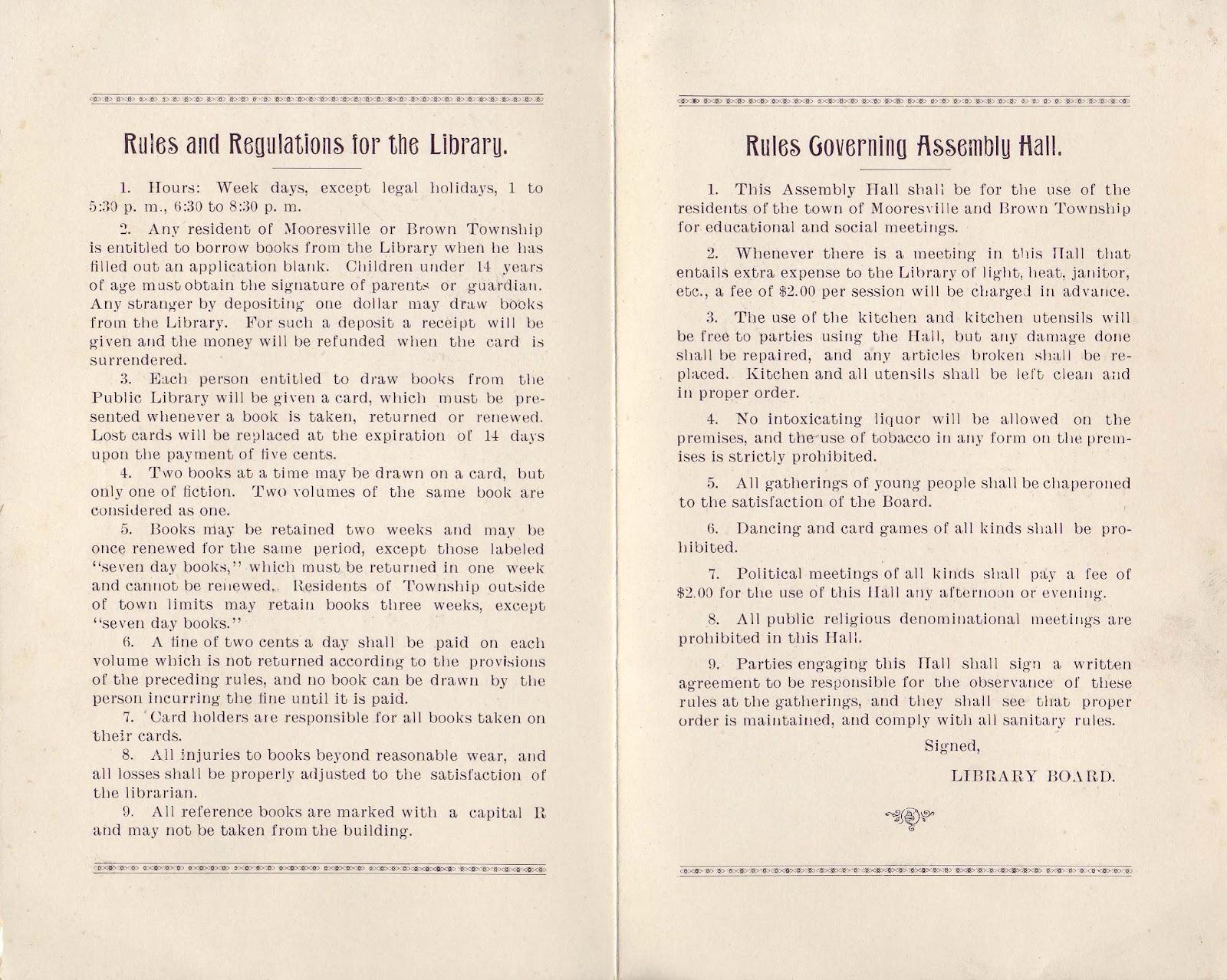
During 1917, Mooresville Public Library began expanding its public services by allowing its basement assembly hall to be used for community and organizational meetings and banquets.  There were rules, of course, for how the area was to be utilized.  These had been adopted the year before, when the "Carnegie" Library building first opened.

Library Rules Governing Assembly Hall Use (1916)

Although the rules had been adopted in 1916, most of that year had been spent consolidating the Library's collections, acquiring new materials, circulating items, and concentrating upon library card issuance and patron registration.  The Library registered 684 new patrons in 1916.  This patron list was too large to scan on our flatbed digital scanner, so we took digital photographs instead.  Click each image to enlarge.  If they're still too small to read, right-click each image and then select "open link in new tab" or "open link in new window."  From there, you may zoom-in to enlarge the view.


The Library's patronage increased dramatically when the government of Madison Township (Morgan County), which is immediately east of Brown Township, agreed to support Mooresville Public Library in exchange for use privileges. Madison residents joined those of Brown and Mooresville in 1920, and this cooperative arrangement continued through 1928, when Madison citizens decided to discontinue the partnership due to financial reasons.

Why did Madison Township residents join MPL during the "Roaring Twenties"? Mooresville is closer than Martinsville to most Madison Township dwellers, and during the 1920s, Martinsville had its own public library but no branches throughout Morgan County. (Today, Morgan County Public Library serves all townships in the county except Brown, which is served exclusively by MPL.)  So it was a simple matter of transportation and time.  Country roads throughout the county were mostly unpaved, rendering travel troublesome during wet weather.  This resulted in lengthy driving times of an hour or more that today could be covered on modern highways in a matter of minutes.  Madison residents wanted access to a library but didn't want to drive any further than necessary, and in the 1920s, Mooresville's Carnegie Library was the most logical option available to most Madison families.

MPL History on Display
Outside the Library's Indiana Room

For most of America, the Great Depression (1929-1941) was a period of economic difficulties, and many governmental services floundered.  Fortunately for its patrons, Mooresville Public Library expanded during the Depression.  According to the Mooresville Times, June 24, 1937, a copy of which is currently on display outside the MPL Indiana Room, the Library's collections (by 1937) had grown to 8,400 volumes, which was actually beyond its anticipated capacity.  There were 2,245 borrowers registered with the Library by 1937.  To accommodate the dramatic increase in patron use of the Library, additional staff and volunteers were recruited.  Clearly, the Library was a staple of the town and community.

Why such growth?  People couldn't afford to purchase books for themselves--many could hardly feed and clothe their families during the 1930s--and so having a public library from which they could borrow books, magazines, and other resources was essential.  Taxpayers were grateful to have a well-stocked, professionally-operated library in town at their convenience.  Those who worked at the Library were likewise grateful to serve their neighbors (and, frankly, to have jobs).  It was a perfect example of how communities support public enterprises for the common good during arduous economic times.

This mutual support extended to other Library activities.  When the Library withdrew materials, these were immediately donated to local school libraries that needed and wanted them.
Helen Stone Keller
MPL Director & Librarian (1922-1939)

Much of the Library's growth and expansion of public services during the "Roaring Twenties" and Great Depression is attributable to its director and librarian from November. 1922 to 1939, Helen Stone, who became Helen Stone Keller following her marriage to Chester Keller.  Her nearly two decades of leadership firmly established MPL as a community resource of primary importance to the citizens of Mooresville and Brown Township.

More MPL History on Display
Outside the Library's Indiana Room

We have more Library history on display outside the MPL Indiana Room.  Please stop by whenever you have an opportunity during your upcoming visits.  We would love to share our history with you, as we have shared our resources during the past century.

World War II ended the Great Depression, and along with it many social changes came to Mooresville.  The Library evolved into a more modern, sophisticated provider of multiple resources.  Before the war, much of the Library's services had been lending books and periodicals, along with public use of the basement assembly hall for various types of gatherings.  As the end of WW II approached, MPL discovered or invented new ways to help its patrons.  Many of these activities are commonplace today, but in the middle-20th century, they were innovative.  We'll explore this territory in our next installment.

Thursday, March 8, 2012

Library Realia on Display


As part of Mooresville Public Library's centennial celebration, I am putting together a display of MPL history.  An entire 157 years of interesting artifacts (going back to the town's first paid membership lending library in 1855) will be in the Indiana Room display cases.  Be sure to take a look on your next library visit.


Here is some of our library realia already on display.  Watch for more!  It's a work-in-progress.

Want a quick summary of the library's history?  Some of this blog's past postings, too, afford an enjoyable walk along the library's memory lane.

Monday, March 5, 2012

Dedication Day Arrives

Mooresville Public Library
(the Carnegie Building, 1916)
(Photo by J. P. Calvert)

January 27, 1916, was dedication day at Mooresville Public Library.  It was the big event in town at the time, as evidenced by the front page of The Mooresville Times (January 28, 1916).  Click each image below to enlarge.

Laminated Copy of The Mooresville Times
January 28, 1916 (Vol. 27, No. 14)

I could paraphrase the newspaper articles, but there's something charming about reading accounts contemporaneous to the events described.  So please click the images below to read the original stories.  If the newspaper clippings appear too small (even after enlarging), then click here to see digitized versions of the articles as PDFs.


Reading the original newspaper makes you feel more like you were actually there at the time.  This is a historical artifact of enormous importance, because it is the only copy MPL has of the first two pages of that particular Times edition.  The microfilm copy in the MPL Indiana Room Collection, which the Indiana Historical Society filmed from paper copies available at the Indiana State Library, omitted the January 28, 1916 issue of The Mooresville Times.  Apparently, the State Library did not have a paper copy of that particular edition.  So this yellowing, laminated original is the only record MPL has of the Carnegie Library's dedication.

The Carnegie Library was a showcase of Mooresvillian civic pride. The structure sat 40 feet north of the front of an 80-ft.-by-153-ft. lot.  The 56 ft.-by-36-ft. building was constructed in an Elizabethan architectural style.  The exterior was vitrified fire clay brick (four shades of tan) inlaid using dark brown mortar, with stone trim and twin gables.  The original roof was tile.

The Carnegie Library employed a steam heating system and, of course, no air conditioning, which didn't generally exist in 1916 (although American scientists had experimented with A/C as early as the mid-19th century).  Interior lighting was semi-indirect, meaning that some were overhanging lights while others were recessed behind wall plating.

The reading room consisted of three adult tables, three children's tables, and two reference tables (for librarians' use).  The basement included an auditorium with a seating capacity of 300, which could be utilized by local organizations and school groups for meetings, programs, and events.  It was the forerunner of today's MPL Bonita Marley Community Room.  In addition, the basement was equipped with a complete kitchenette.

The 4,000 square foot facility initially provided shelving for 6,000 books, which was subsequently increased (during the 1920s) to 8,300 volume capacity. The library's initial collection featured 1,143 books, or less than half the number of volumes currently contained within the MPL Indiana Room (2012). But acquisitions steadily increased, so that, by 1937, the Library housed 8,400 books and had 2,245 borrowers.  By 1936, the Library's annual circulation of books was 20,250.

Quick quiz!  How many items does MPL currently have in its various collections?  Take a wild guess.  Well, let's check the latest inventory report.  As of this very minute, MPL has 86,232 items in its collections.  Were you close?  I'd have wagered around 90,000, but then I have access to the reports.

The 1916 Library Board published the Library's policies on cards distributed to the public.  These were nicely printed on classy cardstock, which were disseminated when patrons obtained their first library cards.

MPL's First Library Policies (1916)

Inside Pages of MPL's First Library Policies (1916)

MPL Library Board of Trustees & Librarians (1916)

The Library also posted its rules for using the assembly hall downstairs.

Library Rules Governing Assembly Hall (1916)

Now that Mooresville had its own fabulous library, residents of neighboring Morgan County townships were interested to see if they could utilize this valuable community resource.  Madison Township residents were the first to seek lending rights to MPL.  Did they succeed?  Find out next time.

Philanthropy Delivers the Dream

On January 9, 1913, the Carnegie Corporation formally offered the Mooresville Public Library Board of Trustees a $10,000 grant to construct the town's new library building.  This offer was acknowledged on January 17, 1913, when Dr. C. L. Hallam, Secretary of the Library Board, sent the following letter, of which we have a photocopy.  (As always, please click the images to enlarge.)

Letter of Acknowledgement of $10,000 Carnegie Grant Offer
From Dr. C. L. Hallam, Library Board Secretary (Later President)
January 17, 1913

Legally speaking, Dr. Hallam's request for a $12,500 grant amount (rather than $10,000) would be construed as a counteroffer.  The Carnegie Corporation must have been disinclined to increase the sum, as the Library formally accepted the original $10,000 offer on May 4 & 6, 1915.

Library Board Formally Accepts $10,000 Carnegie Grant Offer
by Resolution (enacted May 4 & 6, 1915).


Why the two-year delay?  The Library Board minutes remain silent on this point, but one may make some reasonable inferences, based upon an understanding of how local Hoosier governmental spending was driven at the turn of the 20th century.  As part of the grant application process, the Library (and the Town of Mooresville, Indiana) were required to furnish statistics as to how much revenue the library tax levy, which was authorized in May, 1912, would generate for an "annual income" to the library. To make this determination, the town (and Brown Township) government needed to actually collect tax dollars and determine the sustainability of an annual budget from the town (and township) coffers. That meant at least two taxing years (1913-1914) were needed to accurately gauge, or trend, incoming tax revenues.  Once this data was compiled, construction began in earnest during 1915, following formal acceptance of Carnegie's offer.

While awaiting the tax revenue reports, the Library Board considered multiple construction bids and proposed contracts for furnishings, supplies, and other resources.  Considerable effort was expended to maximize the purchasing value of the $10,000 grant.  


Construction began in 1915 and proceeded rapidly.  By December 20, 1915, the work was nearly completed.  Library Board Secretary D. B. Johnson applied to the Carnegie Treasurer to secure the final $2,000 installment of the $10,000 grant.  The Library was formally dedicated a month later.

Consider that $10,000 in 1915 dollars built an entire library for the citizens of Mooresville and Brown Township.  Roughly speaking, how much would that sum purchase in today's dollars for our library?  Find out by clicking here.  [Thanks, Indiana State Library, for furnishing our Library Services & Technology Act (LSTA) grant to make that purchase for the MPL Indiana Room.]

In our next installment, we'll attend the library dedication ceremony.  Well, sort of.


Tuesday, February 21, 2012

Andy Gives the Thumbs Up

The first Mooresville Public Library (MPL) board of trustees held its inaugural meeting on June 21, 1912.  The first board members were:  Dr. C. L. Hallam and Dr. W. L. Thompson (appointed by the Mooresville Town Trustees); Mrs. W. H. Sage and D. B. Johnson (appointed by the School Board); and Mrs. W. F. Hadley, Pearl Bradley, and H. C. Scearce (appointed by the Morgan County Circuit Court).  At its first meeting, the board elected Johnson president; Mrs. Sage, vice president; and Dr. Hallam, secretary.


Some of the first library board members also served
on the Mooresville School Board
(from the 1909 Mooresville High School Senior Annual [yearbook])
(click all photos to enlarge)


Dr. William L. Thompson (right), Mooresville, IN physician (ca. 1909)
(Photo by J. P. Calvert)

Dr. William L. Thompson (1920) (Photo by Manley Brown)
Both photos (above) were taken outside Dr. Thompson's offices
at 31 South Indiana Street in downtown Mooresville


One of the Library board's first actions was to recommend that Brown Township (Morgan County) citizens be invited to join the Town of Mooresville in supporting the Library in exchange for lending and use privileges.  G. R. Scruggs, Brown Township Trustee, was named ex officio to the Library board, and Mrs. W. H. Henderson served as Brown Township's Library board representative.

G. R. Scruggs (at age 86) (1940)

In 1920 the residents of Madison Township (Morgan County) joined Brown and Mooresville to support and use the Library, but fiscal constraints compelled Madison to withdraw from the arrangement in 1928.

Sarah Scott Edwards, Librarian
First Library Director
Mooresville Public Library
(March 1913-August 1913)

Sarah Scott Edwards Montage


At its next meeting, July 3, 1912, the Library board decided to request funding from the Andrew Carnegie Foundation.  Would a stipend be forthcoming to construct the new library facility?  Well, it's sort of a trick question, since we know the Library was, in fact, constructed.  Andy gave the thumbs up (well, his foundation did, anyway), and so $10,000 was granted to the Library board to construct its new building at 30 West Main Street.  The Town Board had purchased the 80 ft.-by-153 ft. lot in April, 1913.  MPL's first librarian (i.e., library director) was Sarah Scott Edwards, who served from March, 1913 to August, 1913.

Helen Hadley Ward, Librarian
Second Library Director
Mooresville Public Library
(August 1913-February 1918)

Andrew Carnegie
American Industrialist & Philanthropist
His Foundation Built 2,509 Libraries (Between 1883-1929)

Helen Hadley Ward, the second librarian (i.e., library director) of Mooresville Public Library, oversaw planning and construction of the new facility.  T. L. Bookie, an Indianapolis architect, designed the structure, while construction contracts were awarded to Frank Marine and Charles Ferguson, local general contractors, and Sam Wade, another Mooresville resident, who installed heating, plumbing, and electric.  Other local businesses, such as F. E. Carlisle and Wilson & White, provided furnishings.

Sam Wade (1882-1968) at his plumbing shop
on East Main Street, Mooresville, IN

Next time we'll discover the layout of what was commonly known as the Mooresville "Carnegie" Library, which was dedicated on January 27, 1916.