Showing posts with label library. Show all posts

Sunday, March 5, 2023

The Historical Journey Never Ends


Indiana Room at Mooresville Public Library

Just Before the Dedication of the New Addition

(January 26, 2006)

(Last updated:  January 9, 2025).

In March, 2010, during a meeting at Mooresville (Indiana) Public Library, one of my colleagues, Suzanne Walker, who was then the library's youth services director, was discussing a social media initiative with the library's executive director, Diane Huerkamp, and me.  The library had already launched its YouTube channel; we could add Facebook, Twitter, and something called "Blogger," whatever that was, which featured "blogs," whatever they were.  Suzanne envisioned expanding the library's "global footprint" through its use of social media.  We could disseminate our messages far and wide to many more people than merely those who entered through the library's doors.

Suzanne already used Blogger to recommend children's and teen books to read and, along with other staff, was about to create new blogs focusing upon the library's youth services programs.  Blogs could also be used for adult services content.  She suggested I write a blog about the history of Mooresville, Indiana.

Would people read a local history blog, I wondered?  With an Internet already overloaded with trivial, over-personalized content, could an audience be attracted discussing the past of a town with fewer than 15,000 residents?  I doubted it, but I was game to try.

So, on April 3, 2010, I "published" my first "post" to this "blog."  Re-reading it now, the tone reminds me of a standup comic whose tired old material is bombing but who doesn't want to surrender the stage in humiliating defeat.  Of course, I was just starting this journey, so I didn't know exactly where I was going or how I planned to get there.  Maybe I should cut my former self some slack.

Thirteen years later, I've reached the end of my library career.  I've written a few hundred blog posts here, as well as over a thousand elsewhere (on four other blogs, two of which are long gone from the web, but two of which are still around here and here).  As of January, 2025, I've reached over 400,000 views with this local history blog; I reached another million views on my other blogs, and over 2.77 million views on the library's YouTube channel.  Suzanne's social media initiative was a success beyond our wildest expectations.

As my retirement date approaches (May 6, 2023), I look back fondly upon the historical tales we've shared here.  Looking back is what historians do; since I've been portraying one at the library for the past 16 years, I wanted to stay in character until my last day, when I will close the library's Indiana Room (and, as manager-in-charge, the library) for what will be my final time.

This blog will remain online until such time as Google (or whoever will control the Blogger site) decides otherwise.  Links to PDFs will remain active until Mooresville Public Library updates to new website servers.  This blog has been a rewarding experience that, with any luck, was somewhat informative and, perhaps, mildly entertaining.  I'm grateful for the support I've received from the library board and the library's executive director (Diane Huerkamp, who retired at the end of December, 2024).  Not many employers would have tolerated my spending endless hours turning out this tripe.  They always had encouraging words for my efforts.  I appreciate that.

There's much local history to be found on these blog posts.  If you've enjoyed it, thank one of my predecessors, Wanda Potts (MPL Indiana Room librarian, 1966-2002, and assistant director from the 1970s to the 1990s) for creating and maintaining the historical collections from which I've drawn everything.  Also thank Bonita Marley (MPL executive director 1961-1984), who preserved all the local history filed before Wanda came aboard (and handed it over to Wanda to preserve thereafter).  Myrtle Keller (MPL staffer & assistant director during the 1960s and 1970s) also contributed to the library's historical collections, as did each of the library directors and staff before Mrs. Marley.  My immediate predecessor, Marylou Smith, also deserves kudos for her fine work preserving Mooresville's past.  None of the material I've presented here (or elsewhere) regarding local history would have been possible without their tremendous efforts to organize and safeguard it.  All I did was type and upload some images.

Finally, thank YOU for reading about Mooresville's past.  Local history collections are diminishing in public libraries these days, so having an interested audience has helped Mooresville Public Library continue its mission to protect the past for the future to explore.  I hope the library's Indiana Room resources will be around for many years to come.  History continues forward, so there will always be something new and fresh to discover.  The historical journey never ends.


Saturday, February 11, 2023

Your Source for Monrovia History

Roughly seven miles southwest of Mooresville is the town of Monrovia, in Monroe Township, Morgan County, Indiana.  Founded in 1834 (ten years after Mooresville), Monrovia was incorporated in 1995 and has a current population of 1,641, as of the 2020 U.S. Census, according to the town's website.

Google Map Showing Monrovia & Mooresville, Indiana
(Click Images to Enlarge)


Monrovia has a long and proud history, and Mooresville Public Library's Indiana Room has some of this information, but if you're really interested in Monrovia history, you should speak with the expert:  Steve Reeder, a history & psychology teacher at Monrovia High School.  Steve knows the history of Monrovia, Monroe Township (and neighboring Gregg Township), and northern Morgan County like the proverbial back of his hand.  His general Morgan County historical knowledge is pretty awesome, too.  When I have a question about Monrovia and vicinity, I contact Steve.  So should you.


Steve Reeder

Monrovia High School


In 2021, Steve received the WISH-TV Channel 8 Golden Apple Award for outstanding teaching, particularly in preserving and promoting history (and, specifically, local history) for and to students and the overall community.

Steve works with students at Monrovia High School to create exemplary local history videos in his Monrovia Moments series, available to watch free on YouTube.  Everyone interested in Monrovia history should definitely subscribe to this channel.  You won't find better local history videos on the Internet.

Besides consulting Steve, those of you with local history questions should also visit the Monrovia History website, as well as the Monrovia Branch of Morgan County Public Library.  For Morgan County history in general, you should visit the Genealogy Department at Morgan County Public Library (main branch in Martinsville), as well as the Morgan County History Center & Museum (also in Martinsville).  Another terrific resource is the Morgan County History & Genealogy Association website.  Of course, Mooresville Public Library's Indiana Room also has many local history materials for the region (and for Indiana overall), so you should surely visit there, too.


Saturday, January 28, 2023

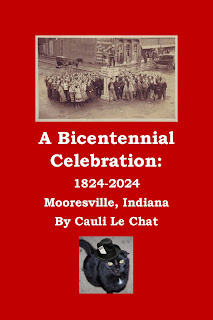
Mooresville's Bicentennial Book: a History for Kids

HEY, KIDS!  Learn about the history of Mooresville, Indiana from Cauli Le Chat, feline roving reporter at Mooresville Public Library.  Click the book cover (below), or click here, to read a digital copy (in PDF format).  Just in time for Mooresville's bicentennial celebration (1824-2024)!

NOTE FOR PARENTS AND TEACHERS:  If your child(ren) (or the children you teach) attend elementary school grades 3 or 4, then this book will be particularly interesting to them, because they will be studying Indiana history in those grades.  Younger and older readers might enjoy the book, too.  Try reading it aloud to your preschoolers and early grade schoolers.


For those who prefer print books to digital, Mooresville Public Library has paper copies available to checkout, if you have an Evergreen Indiana library card. Visit the library's Indiana Room to pick-up a copy (Call Number I 977.251 CAU). See the Evergreen Indiana online catalog for details.

If you have an Amazon Kindle reader, a Kindle edition is available to buy from Amazon for $1.99. Paperback editions may also be purchased from Amazon for $6.50 plus shipping and handling.

 Here's a book trailer (below) that briefly describes what to expect:


A Bicentennial Celebration (Mooresville, Indiana),

by Cauli Le Chat (MPL Book Trailer 865)

(Click Video Above to Watch) 


Thursday, December 22, 2022

Noel Plunkett's Library Video (May/June 1987)

Those familiar with the history of Mooresville Public Library (MPL) know that construction of the "new" library building began in June, 1987.  The library is fortunate to have a VHS videotape recording made in May/June 1987 by Noel Plunkett, which shows the "old" library Carnegie building located at 32 West Main Street in downtown Mooresville, Indiana, as well as the construction site for the "new" library, which I call the 1988 building.

What good is a VHS cassette, you may well ask.  Who has videocassette recorders (VCRs) anymore?  Thankfully, there are wonderful gadgets that can convert videotapes into DVDs or digital recordings, and the library has such a gizmo.  Yesterday, I converted the videotape to DVD and digital formats.  Then, I took the raw video/audio and made a quick edit using Wondershare Filmora software.  Here's the result:

Mooresville Public Library, May/June 1987 Video, by Noel Plunkett

(Click Above to Play Video)


Mr. Plunkett's video begins by showing the front exterior of the MPL Carnegie building, then moves to selected interior shots.  Three MPL employees were captured on videotape:  MPL Director Sharon Beatrice, MPL Assistant Director/Indiana Room Librarian Wanda Potts, and MPL Staffer Mattie Deaton.  Then, Mr. Plunkett moves a few blocks west to 220 West Harrison Street, where construction began (in June, 1987) on the 1988 building.  Several unidentified construction workers appear in the video.  Mr. Plunkett provides a couple of voice-overs during the recording, in which he states the date of videography at the construction site.


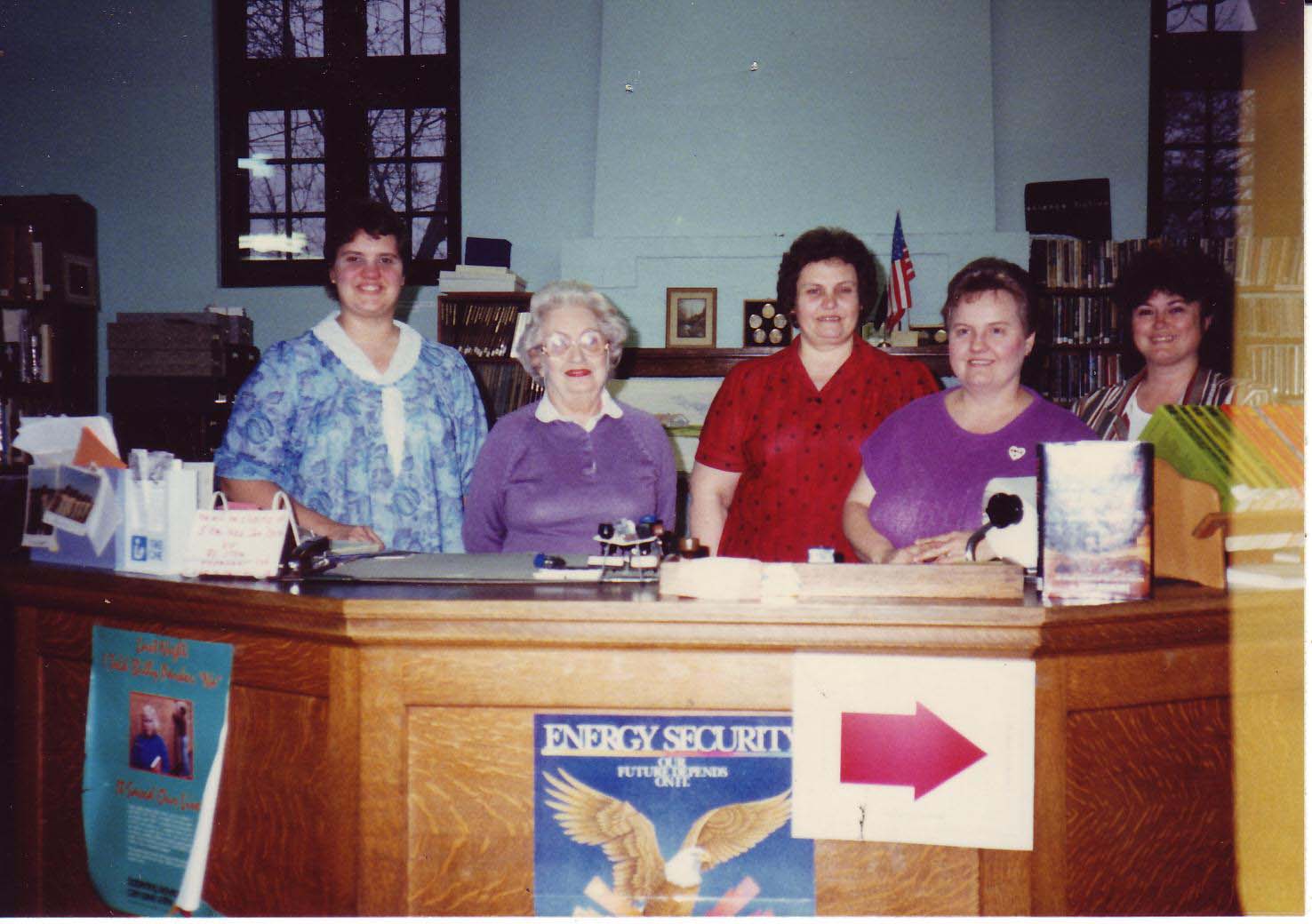
Wanda Potts & Mattie Deaton appeared in this photo
of MPL Carnegie's last day (January, 1988)
L to R:  Director Pat Vahey, Asst. Dir. Wanda Potts,
Staffers Mattie Deaton, Theresa Lucas, and Sandy Lefler


MPL Director Sharon Beatrice (1984-1987)

Indianapolis News, Monday, June 15, 1987


The original video quality was low-resolution, and the audio was captured by a condenser microphone on the camera, so it is difficult to hear.  Retail camcorders from the mid-1980s filmed in analog, so the recording appears fuzzy on modern digital video players.  The quality, however, was standard for the retail market of the mid-1980s.

Mr. Plunkett's video is an invaluable historical account that captured the look and feel of the library (and construction site and its surroundings) from the time period.  Captured, too, were images (and faint voices) of some of the library staff from way back then.  For those who lived in and around Mooresville during the 1980s (and who frequented the library), it will bring back fond memories, as well as revealing what the library's current site looked like as construction began.  Sadly, such historical artifacts are often discarded, damaged, or otherwise lost as the years pass.  We are grateful that Mr. Plunkett donated a copy of his videocassette to the library, and that library staff had the foresight to preserve it.


Tuesday, April 12, 2022

Enhancing the Digital Footprints of Library Local History/Genealogy Departments

At one time, public libraries determined their overall effectiveness in serving the public based upon door count, i.e., the number of persons entering the building.  With the advent of online history and genealogical resources, increasing numbers of people are using the Internet (rather than visiting their local libraries) to conduct their genealogical research or to learn about their communities' histories.

How, then, does a library reach patrons who don't physically visit the facility?  Many libraries have found social media as their new pathway to patrons.  Videos, podcasts, blogs, and posts to such social media sites as Facebook, Twitter, Instagram, Pinterest, and others have become effective mechanisms to reach a new, different audience than those coming through the library doors.

These two slideshows, along with a handout (links below), summarize some of the resources available for history/genealogy librarians to use in creating a digital footprint.

Mooresville (Indiana) Public Library has several videos on YouTube to illustrate how local history may be brought alive visually.  Watch this playlist to learn more.


Indiana Room at Mooresville (Indiana) Public Library 
(MPL Website's Digital Indiana Room Available Here)


Thursday, August 5, 2021

"Dating" Citizens Bank

Norman Connell
 
(Updated, December, 2024)

Norman Connell (Mooresville High School, Class of 1957) was president and CEO of Citizens Bank from 1975 until his retirement in 2001.   Norman started his career at Citizens Bank in Mooresville, Indiana in 1961 following his discharge from the U.S. Air Force.  He saved some undated, unidentified photos showing Citizens Bank when it was located on the southeast corner of Main and Indiana Streets in downtown Mooresville.  How can we date those pictures?

Knowing when Citizens Bank was at this location is a first step.  According to a Mooresville Public Library (MPL) handout, Citizens Bank occupied 3 East Main Street from 1931 to 1966.    That is a fairly large time range, however.  So our next step is to examine the photos themselves for dating clues.  (Click on the images below to enlarge them.)

(As a quick sidebar:  This structure in the photo below was commonly known as the Bass Building, constructed around 1890 and demolished in 2022 after being destroyed by the April 2020 tornado.)

There's a story behind the clock hanging on the side of the building (above).  We'll talk more about that at the end of this blog post (scroll to the bottom if you want to skip ahead; otherwise, read on).

This exterior shot of Citizens Bank (above) shows late 1950s automobiles, as well as Copeland Appliances, in the background.  The same MPL handout lists Copeland Appliances at 16 South Indiana Street (which appears in the background) from 1956-1974.  (Copeland Appliances was also located at 18-20 South Indiana Street between 1950-1974, but that's further down, out-of-shot.)  So, given these three bits of information, we can safely assume that Mr. Connell's Citizens Bank photos were taken between 1956-1966, the latter date being the last Citizens Bank was situated at the location shown. 

Can we further narrow the time frame?  Let's look at some interior photos of Citizens Bank.


See the calendar in the photo above?  It says, Saturday, July 20.  The twentieth of July fell on a Saturday in 1957 and in 1963.  That cinches the date.  These photos were taken on Saturday, July 20, 1957 or 1963.  But there's one factor that suggests 1957 as the correct date, and that is the photographers/developers.


How do we know that these photos were all taken at the same time?  They are all printed on the same type of photographic paper and appear to have been taken by the same (or a similar) camera.  More to the point, they were taken and/or developed by the same two photographers/developers, Squires Studio and Awbrey's Photo Service, both of Mooresville during the 1950s.  Their stamps appear on the backs of the photographs (see below).


What did Citizens Bank look like inside on Saturday, July 20, 1957?


Here are some Citizens Bank employees who were working that day.  None of the photos identified the persons shown, but thanks to Norman's wife, Ruth Connell, we were able to identify three of them.  You can contact Mooresville Public Library if you recognize any of the others (the library now has these pictures in its Indiana Room's banking vertical file).

Martha Sellars, maybe

Identifying Miss Sellars would be fairly easy--her name plate appeared in the photo--unless, of course, it's somebody else standing at Miss Sellars' window when this photo was taken.  So we would need another photo of Martha Sellars to compare against this one, if we're to be sure that this is Martha Sellars.  Guess that takes us back to square one.  (I seem to recall that Ruth Connell identified Martha Sellers in this picture, but I may be misremembering.  I think that's how I knew her first name was Martha, so I'm prepared to go with Ruth on this one.)


Thelma (Blaschke) Weddle and Ed Fields


Always identify the people, places, circumstances and dates of your photographs.  They might be of enormous local historical value, especially for historians and researchers.  If  you're reading this article, wouldn't you like to know those details about these "slices" of living history?

The Exterior Clock's History


In the photo (above), there's a clock hanging from the exterior of the building.  Assuming the photo was taken in 1957, we could surmise that Citizens Bank displayed such a clock at that time.  To confirm whether the clock was there then, we could, of course, compare this picture against others shown in digitized copies of Mooresville High School yearbooks from the 1950s and early 1960s, before the bank moved to its present location (in 1967) on North Indiana Street (across the street from 3 East Main Street, where it was in these photos above).  (Mooresville Public Library's Indiana Room has print copies of these yearbooks, if you'd prefer looking through those.)  One thing's for certain:  the clock was there, and it had been, in fact, since 1931, as shown in the photo (below).


1931 Citizens Bank photograph shows the exterior clock (far right)
on the Bass Building (courtesy of Citizens Bank)

Citizens Bank, which began in 1931, acquired the exterior clock from its predecessor, Farmers State Bank, which went out-of-business in 1930.  We know this because we can see the same clock as shown in advertising from 1917 and from check logos from the 1920s.


1917 advertisement from the Mooresville High School yearbook


Counter checks (1920s), with clock shown above entrance

The clock first appeared on the Farmers State Bank building in 1904, when it underwent a major renovation.  You can see the clock hanging above the entrance in this photo (below).


1904 Photo from a Farmers State Bank brochure
(Enlarged below)


You can tell it's the same clock (or, at least, the same exterior casing that holds the clock) if you compare the 1957 Citizens Bank photo with the 1904 Farmers State Bank photo and 1917 advertisement.

When Citizens Bank vacated the Bass Building to move across the street in 1967, the clock apparently didn't accompany them.  At least it doesn't appear in this photo below.


Citizens Bank advertisement photo (1967)
courtesy of Mooresville High School's yearbook,
Wagon Trails


Where did the clock end up, you may wonder?  I certainly did.  Then, one day, I noticed something incredible.  There's a clock atop a post on the south side of West Main Street, next to a parking lot (and a drive-through bank teller building), which is across from Mooresville Public Library's old Carnegie building, which is now used by Citizens Bank (plot point!).


Clock on the South Side of West Main Street
Downtown Mooresville, Indiana
Three photos (above) courtesy of Google Maps (October 2024)


The clock face is approximately the same size as the one shown in the Citizens Bank/Farmers State Bank exterior hanging frame.  What caught my attention was the clock face.  Look carefully at the numbers, especially seven.  Do you see the odd curve at the bottom of the seven?  There's a strong resemblance between the clock face number styles!  Compare the photos (below) and see what you think.


West Main Street Clock
(photo by William R. Buckley)
(December 18, 2024)


Enlargements of the 1957 photo of the exterior clock face
on the Citizens Bank building


Admittedly, it's not a perfect match between clock face number styles shown in the 1957 and 2024 photos, but their similarity is striking, and given the approximate equality in sizes of the clock faces themselves, we might surmise that the clock face currently displayed on West Main Street is the same clock, or, at least, a similarly styled clock, as the one that was once attached to Citizens Bank and, possibly, Farmers State Bank.  It's an intriguing supposition.

But that's not all we have to go by.  A few years ago, during a downtown historic walking tour I gave for patrons of Mooresville Public Library, one woman saw the clock and said that her father, who had once worked at Citizens Bank, had told her that the clock on West Main Street was the same as the hanging clock from pre-1967 Citizens Bank.  Unfortunately, we have misplaced her name, but we think she may have been Norman Connell's daughter (see photo at the beginning of this blog post).  How's that for circling around to where we started?


Saturday, March 27, 2021

Find Out Why

To celebrate National Library Workers Day (April 6, 2021), Mooresville Public Library deputy director Sandra Osborn has written and produced a promo trailer showing that MPL staff's collective 139 years of experience helps patrons find out why.


Find Out Why (Promo Trailer)

by Mooresville Public Library

(Click above to play video)


Drop by the library and discover that experience matters.


Thursday, March 25, 2021

How the Past Inspires Us (High School Edition)

Being a local historian (sort of) at Mooresville Public Library, I am often asked to unlock one of our glass storage cabinets to allow patrons to peruse yearbooks from Mooresville High School.  We began digitizing these yearbooks a couple of months ago (thanks to OCI Digital Imaging Service), and some are now available to view online (see this blog post).  Even when we have completed the project, I anticipate that patrons will still visit the MPL Indiana Room to request the bound paper versions of these yearbooks.  I hope so.  Holding the past in your hands can be thrilling.

From 1946 onward, the MHS yearbook has been called Wagon Trails, in line with the school's nickname (Pioneers).  One day I happened to be looking through the 1976 edition of Wagon Trails (from the year my wife graduated from MHS) and stumbled across the speech team (pages 98-99).  I was a member of a speech and debate team when I attended a different high school (also graduating in 1976), so I stopped for a quick look.  I discovered something inspiring.


 From Wagon Trails, page 99

Mooresville High School Yearbook

(Click Images to Enlarge)


This was meaningful to me because I attended the same state speech tournament as Greg 45 years ago around this time (Saturday, March 20, 1976, if memory serves), in my case representing another school (Lafayette-Jefferson).  I never met him, but his performance is inspirational for someone interested in high school public speaking competitions.  To reach the IHSFA (Indiana High School Forensic Association) state speech tourney, Greg would have had to have placed among the top five in his speaking event in the super-tough west Indianapolis regional meet, which included powerful Ben Davis High School, the largest high school speech team in Indiana at the time.

I don't know in which speaking category Greg participated--maybe it was Radio, or perhaps Boy's Extemporaneous (my event), Impromptu, Dramatic Interpretation, Original Oratory (I really have no idea--just guessing)--but reaching state finals was no easy chore.  It took an enormous amount of practicing and competing in weekly tournaments at high schools across the state to prepare for the "big game."

Here's where Greg's example could be inspiring.  If I were an MHS student participating in speech contests today, knowing that a previous alumnus had excelled--especially if I were competing in the same event(s) as that alumnus--could encourage me to work a little extra.  Maybe I, too, could make it to state finals, like Greg did.

As it happens, when I attended Lafayette-Jefferson, I was deeply inspired by my predecessors who won state championships or NFL (National Forensic League) district tournaments to qualify for the NFL National Tournament.  Legendary speech and debate coach James F. Hawker--my coach--had had dozens of students win top state and district honors and attend Nationals.  His two national speech team championships (1964-1965) and eight consecutive  years of state speech team championships (1958-1965) was an amazing run.  (Imagine your high school basketball team winning the state tourney eight years running.)  I studied what my predecessors had accomplished, knew all their names and dates of participation, and idolized their achievements.  Perhaps I, too, could be among them?  Well, at least that was the dream.

So I practiced every day after school throughout my time at Lafayette-Jeff, inspired by past glories.  I didn't have to look to the past only--many of my teammates became state and district champions and attended Nationals, my older brother Alfred among them--so inspiration was close at hand.  But it was the "old" former students from the "glory days" who most captured my imagination.

Of course, inspirations from the past can come from many different aspects of life, not just high school contests.  But the high school example is poignant.  Don't we all remember watching our school's sports teams play?  Haven't we all walked past high school trophy cases filled to the brim with past fulfillments?  Does your high school have its "wall of fame" with the names of honored past performers?  For those of us involved in non-athletic extracurricular activities, we followed the achievements of our schools' bands, orchestras, choirs--even our newspapers, yearbooks, art clubs, and business teams (DECA and ICT, although I can't now remember what the acronyms stood for--distributive education?)--as they competed with students from other Hoosier schools.  Americans love achievements--especially championships--so there was lots of inspiration available.  Our classmates (and particularly those who came before) accomplished great things.  Maybe we could, too.

Drop by the MPL Indiana Room and look in our glass display cases at Mooresville High School's state finalist girls' basketball team from 1978, or its regional champion boys' basketball team from 1944.  (The boys won regionals in 1977, too, but there's only so much room in our display cases.  Sorry.)  As you look at their faces, can you feel their excitement?  Those are just two examples of many others available to see in MHS yearbooks.   And that's just one sport among many.  Then there are the non-athletic groups.  What about the MHS orchestra's state championship in 2011?  If you're interested in something, those who preceded you can inspire you to greatness.

The past can encourage the future.  It worked for Greg Haught.  Greg's example (and countless others) can work for today's students, whose achievements may spur tomorrow's youngsters.


Martinsville Reporter

Friday, June 4, 1976, page 3


(I was a political science major at Indiana University-Bloomington at the same time Greg was.  Small world, although not small enough--I never met him down there, either.  But the example is worth noting--winning scholarships is no easy feat.  Take note, all you kids out there.  That extra hard work will pay off.)


Tuesday, October 27, 2020

New, Improved Legacy Links (Mooresville Obituary Database)


Mooresville Public Library has its own obituary database called LEGACY LINKS, which includes over 20,000 obituaries, primarily of deceased residents of Mooresville and Morgan County, Indiana. This database has been redesigned (in Fall 2020) to provide a more user-friendly interface.


Thursday, October 22, 2020

Friday, August 7, 2020

The Library's First "Spokescritter"

Mooresville (Indiana) Public Library has had many resident animals over the years--birds, lizards, salamanders, turtles, fish, mice, guinea pigs, gerbils, a ferret--but, so far as I know, there has been only one feline roving reporter.

One cold December day in 2010, I saw a black cat hanging out by the library's front entrance.  As patrons came and went, the cat would run alongside for a few feet, mewing pitifully.  Although she looked reasonably well-fed, I presumed she was a stray (or had been cruelly dumped to fend for herself), so I telephoned my wife, who promptly brought canned and hard cat food from home to share with our new feline friend.  As the temperature was likely to drop well below zero by nightfall, and the library was closing shortly, we didn't have time to canvas the neighborhood, so we decided to give the kitty shelter for a few days until the weather warmed up.  So we took her home.

We called  her Cauliflower, as she had a bad ear from some past feline fracas.  Then we began to consider what to do with her.  We felt a bit guilty "catnapping' her, in case she had lived close to the library.  We didn't want to deprive someone of a beloved pet.  We took her to our veterinarian, who said she was probably four years old and was healthy.  She wasn't too pleased about receiving a battery of shots, though.

With warmer temperatures arriving a few days later, we returned Cauliflower to the library and allowed her to make her own way back where she came from, watching closely to ensure she came to no harm from careless drivers.  Cauliflower sauntered down the sidewalk for a block or so, walking directly to the front door of a house where several outdoor cats congregated.  We suspected that this was Cauliflower's point of origin, but, as we later learned, it was hardly a "forever home."

A few hours later, I happened to be walking around outside when I saw Cauliflower in the library's exterior Kindergarden area, searching for prey among the bushes.  This time, I carried her to the house she had previously walked to and rang the doorbell.  An irritated occupant answered the door.

"Is this your cat?" I queried.

"Maybe," said the occupant, who looked fairly seedy.  "I don't pay much attention.  We got a whole lotta cats that live in the barn."  It was, at best, a dilapidated shed on the rear of the property.  There must have been half a dozen cats lying around the broken shed door.

That decided the matter as far as I was concerned.  "If you're not sure she's yours, I'll ask around the neighborhood."

"Okay."  Occupant shut the door.

None of the other nearby residents claimed Cauliflower, so I returned her to the library, and, later, took her to my home again.  She subsequently decided she liked living at our neighbor's house better than with us, so she began spending most of her time there.


Cauli Le Chat, official MPL feline roving reporter (2010-2019)

 Cauli Le Chat the MPL "Spokescritter"


Since we had discovered Cauliflower roaming around outside the library, my wife suggested that she should be put to work, if we were going to feed and shelter her.  "Maybe she could be your library's pet, and she could be like a spokesperson for the library," my wife suggested.

"Spokescritter," I prompted.

"Since she roams around town, she could be the library's roving reporter, sharing library news with your patrons."

That was a stroke of genius on my wife's part.  "She could even write a blog promoting the library.  But she needs a catchier name."

My wife thought for a moment.  "If she's a feline roving reporter, she should have a classy name.  Maybe something French, like Cauli Le Chat."

And so a feline blog was born.

Cat's Eye View @ MPL Blog, by Cauli Le Chat (2010-2019)


Cauli Le Chat became Mooresville Public Library's official feline roving reporter, blogging about anything she found interesting at the library, around town, or wherever else that grabbed her attention.  She vigorously promoted the library and Mooresville, her hometown.  She was known for her acerbic, sarcastic tone.  She did not suffer fools gladly, especially among her human "co-workers."  This was an affectation, however; she had a pleasant personality and was friendly toward most everyone.  She posted hundreds of articles to her blog, which were read over half a million times around the world.  Not bad for a cat working at a small township library.

Unlike resident library cats such as Baker and Taylor, Dewey Readmore Books, Tober (and Chance), Browser, Oliver, Porter C. Bibliocat, Carnegie, Elsie, Trixie, and many, many more, Cauli did not actually live inside the library.  Several also predated Cauli's online presence, as did other resident library "spokescritters" like Morgan the Library Bunny.  But Cauli was different in that she played the roving reporter role.  She was designed to report, and, thus, market, the library's resources, events, and activities.

Cauli retired a couple of times from blogging, as she eventually became an exclusively indoor kitty.  She passed away a few days ago.

Cauli's efforts to promote Mooresville Public Library were distinctive compared with those of us who were paid to work there.  She was paid, too--free room and board with "Kindly Couple" and our neighbors--but, most importantly, she was paid with love, which she generously reciprocated.  I will miss her cheerfulness, her good company, and the sheer joy she radiated at being alive and free.