2023 UPDATE: David B. Reddick, of Camby, Indiana, has published a book exploring the origins of the Indiana State Flag. Copies may be purchased from Amazon.com, or you may check Mooresville Public Library's Evergreen Indiana catalog to see if copies are available to checkout.
Reddick, David B. The Indiana Flag: Who Really Designed It? (Fideli Publishing, 2023)
2018 UPDATE: Click the links below to read several excellent biographies of Paul Hadley with information about the Indiana State Flag:
Poletika, Nicole. "'A Permanent Emblem of Its Own:' The Indiana State Flag & Its Designer." Indiana History Blog, January 11, 2017. Indiana Historical Bureau of the Indiana State Library. (Click here to access the blog article.)
"Paul Hadley looks on as Ralph E. Priest, a student at the John Herron Art Institute in Indianapolis, applies gold leaf to an Indiana state flag, circa 1923. When faculty and students at Herron learned that no state flag was on display in the Hoosier capital, they created the one seen here and presented it to the state. The Indiana Historical Bureau now safeguards the flag." [Photo and caption excerpted from Perry, Rachel Berenson. "Paul Hadley: Artist and Designer of the Indiana Flag," Traces of Indiana and Midwestern History. 15(1), 20-29 (2003)].
Paul Hadley's Indiana state flag (see B/W photo above)
now stored at the Indiana State Library
by the Indiana Historical Bureau
(Photo by Cheryl Dobbs, December 2013)
Modest ... Soft-spoken … Dignified … Witty … These descriptions of longtime Mooresville resident Paul Hadley, designer of the Indiana State Flag, reflected the community and state in which he was raised. Born in Indianapolis on Aug. 6, 1880, Paul was one of four sons of Dr. Evan Hadley, M.D., and Ella Quinn Hadley. He switched from Indianapolis (later called Shortridge) High School to Manual Training High School to study art under Otto Stark, one of the famous Hoosier Group of impressionist painters. Paul then studied at the Philadelphia Academy of Fine Arts & the PA Museum & Industrial Arts School. He first specialized in stained glass and interior designs, working for Philadelphia and Chicago firms. Paul helped design the Kennebunkport, Maine residence of Hoosier writer Booth Tarkington. Paul was named “most popular artist” at the 1922 Indiana State Fair. He did not drive a car; instead, he hiked cross-country to paint the scenic views. His ability to capture the essence of his subjects was matched by superb use of color and realism, softened with impressionistic tones.
Out of 200 proposals, Paul’s design for the Indiana State Banner (changed to Flag in 1955) was selected in the state’s 1916 Centennial Celebration, and the Indiana General Assembly adopted it in 1917. The flag’s flaming torch and six radiating beams from the torch symbolized the expansion of liberty and enlightenment. The 13 stars represent the original 13 U.S. states; the five inner stars represent the next five states admitted to the Union. Indiana is the largest star atop the torch.
As an art instructor at the Herron School of Art (1922-1933), he specialized in watercolors and outdoor sketches. Paul became Assistant Curator of the Art Association (1935-36). He travelled the country, capturing distinctively local scenes that defined mid-20th century Hoosier and American culture. He lived in Mooresville, Plainfield, and, finally, Richmond, IN, where he died on Jan. 31, 1971.
2016 UPDATE: Watch these biographical videos to learn more about Paul Hadley.
Paul Hadley Biographical Video, Part One, by MPL
Paul Hadley Biographical Video, Part Two, by MPL
Paul Hadley Biographical Video, Part Three, by MPL
The Paul Hadley/Indiana State Flag historical marker dedication ceremony was held this morning (Saturday, August 6, 2016) in downtown Mooresville, Indiana. Here are a few photos from the event. Click the photos below to enlarge.
The new historical marker awaiting its unveiling
Dave Nash, chairperson, Celebrate Mooresville,
welcomes the audience
Casey Pfeiffer, historical marker program manager, Indiana Historical Bureau,
spoke about the public process used to establish historical markers
(and this marker particularly)
Dave Nash spoke about honoring Paul Hadley
Lois Huntington, State Regent, Indiana Daughters of the American Revolution,
spoke about the Indiana State Flag's legacy
Bud Swisher, Healthier Morgan County, spoke about
personal memories of Paul Hadley and
designing the Indiana State Flag
Janice Bolinger, Honorary State Regent,
Indiana Daughters of the American Revolution,
spoke about the meaning of the Indiana State Flag's symbols
and the historical mysteries surrounding the flag
The unveiling!
The new historical marker!
The front side of the new historical marker
The rear side of the new historical marker
At the beginning of the ceremony, Mooresville Boy Scout Troop 231 honor color guard presented the colors--first, the American flag, then the Hoosier flag.
Also on display at the dedication ceremony was the official Mooresville town banner, designed in 1974 by MPL director Bonita Marley. The town flag is on permanent display in the MPL Indiana Room.
A nice crowd was on hand for the dedication. The marker is located in Hadley Memorial Park in downtown Mooresville (on the northeast corner of the intersection of Main and Indiana Streets). The marker site was also the location of Samuel Moore's general mercantile store, which was the first wood-frame business built in Mooresville (Moore founded the town in 1824).
MPL treasurer Steve Saucerman speaks with
Mooresville Academy museum director/historian Julie Kyle-Lee
MPL president Lynn Adams (right)
Learn more about the history of the Indiana State Flag and Paul Hadley at:
Poletika, Nicole. "'A Permanent Emblem of Its Own:' The Indiana State Flag & Its Designer." Indiana History Blog, January 11, 2017. Indiana Historical Bureau of the Indiana State Library. (Click here to access the blog article.)
As part of Indiana's bicentennial celebration, the Indiana State Banner that was originally displayed at the Indiana statehouse during the 1920s is currently on display at Mooresville Public Library. The original flag will be "on tour" across the state throughout the rest of the celebration. The Indiana State Banner was designed in 1916 by Mooresville's own Paul Hadley; was adopted by the Indiana General Assembly in 1917; and was renamed the Indiana State Flag in 1955. Click here to learn the meaning of its symbols.
Click the photos below to enlarge. The display is situated with our Paul Hadley watercolor painting collection in the grand hall, next to the elevator and the vending machine area.
This flag is shown below in a famous photograph (circa 1923) of Paul Hadley and one of his art students crafting it specifically for the Indiana statehouse to display.
(Photo and caption courtesy of the Indiana Historical Society)
(click to enlarge)
Learn more about Paul Hadley and the Indiana State Flag by visiting our Famous Mooresvillians and local history links blog posts (scroll down until you reach the Paul Hadley sections).
See also Poletika, Nicole. "'A Permanent Emblem of Its Own:' The Indiana State Flag & Its Designer." Indiana History Blog, January 11, 2017. Indiana Historical Bureau of the Indiana State Library. (Click here to access the blog article.)
The Wikimedia scans are of the images that appear in the yearbooks, with original text from the yearbooks extracted from the original scans and typed out (like ordinary text) for easier reading.
These yearbooks were also digitally scanned (showing the entire pages as they originally appeared in print) and stored on the Mooresville High School Alumni Association Facebook page, but access might be restricted to their authorized FB group members. You can check those links, too, to see if you can access them (click below):
The Mooresville High School Alumni Association has uploaded the complete video, Memories of Mooresville (2011), to YouTube. Click the player (below) to watch the entire video, or visit Mooresville Public Library to checkout a physical copy on DVD (learn more from this blog post).
Take our "virtual" walking tour (click link below) of historic downtown Mooresville, Indiana. Then, using this handout, walk the self-guided route yourself.
Can you see what's missing from Paul Hadley's template (first photo, below) he used in one of his many initial designs of the Indiana State Banner? Compare it to Hadley's "official" Indiana State Flag (the one shown below was displayed at the Indiana statehouse during the 1920s). Visit the MPL Indiana Room to check your results!
Click the images below to enlarge them.
Paul Hadley's template for the Indiana State Banner (renamed Flag in 1955)
Paul Hadley made this particular "official" flag circa 1923
to display at the Indiana statehouse
By the way, several of the missing bits were originally included in Hadley's template, except one important modification the state legislature requested when it officially adopted Hadley's winning 1916 design to be the Indiana State Banner in 1917. As you spot the differences, you might guess which bits probably fell off during the template's decades in storage.
In case you missed last Saturday's (April 16, 2016) program about longtime Mooresville resident Paul Hadley, designer of the Indiana State Flag, we have a video available that includes panel discussion and questions-and-answers.
Celebrating Paul Hadley & the Indiana State Flag Centennial
In 1939, Paul Hadley painted this cabin. Well, he painted a picture of
the cabin. I assume somebody else painted the cabin itself. (There's a
great Paul Hadley joke about that. I'll tell you in a minute.)
"Cabin," by Paul Hadley (1939)
(Click photos to bigify)
Paul Hadley (1880-1971), a longtime Mooresville
resident, designed the Indiana State Flag; taught painting at the Herron
Art Institute in Indianapolis; was a museum art curator; and was himself an
accomplished artist (primarily in watercolor). Several of his paintings
are permanently displayed at Mooresville (Indiana) Public Library. We're tracing Hadley's footsteps to see the places he painted and
how they look today.
How do we know when Paul Hadley painted this cabin?
Yep. Pretty much.
The much tougher question is (wait for it . . .): Where was this cabin? Does it still exist? (Okay, that's two questions.) But first, some comic relief.
Paul
Hadley roamed the countryside (literally walking most places near
Mooresville, because he never drove a motor vehicle) painting
landscapes, structures, and other places. Anywhere that was too far to
walk (or that he couldn't conveniently reach by the interurban railway
or other railroad) required Hadley's friends to kindly give him a lift
to the locations. These folks were often repaid with a Paul Hadley
original painting. Pretty sweet deal.
I'm
getting to the joke! Once, when Hadley was walking about, he came upon
a particularly appealing barn that he wished to grace his canvas. He
saw the barn owner and asked if he (Hadley) could paint his (the
farmer's) barn. The farmer replied, "No thanks. I just had the barn
painted last year." (Cue drums and cymbals!)
Back to the tough questions.
According to long-time Morgan County historian Becky Hardin, in her biography of Paul Hadley, she stated:
"This
painting ["Cabin"] was presented to the Mooresville Library by the Tri
Kappa Sorority. A newspaper story says it is 'The Robb Cabin' but some
people think it was the Spoon home. [. . . .] Spoon's Cabin was the
subject of Hadley's Paintings at different seasons of the year. [One
shown in her book] is Spoon's Gate and was probably for his [Spoon's]
cabin. It is owned by one of Hadley's cousins Mrs. Harold Swift. The
gate is something like the one [in "Cabin"], which has an open gate.
Although the location may have been the same the paintings are
different." [Hardin, Becky, The Indiana State Flag: Its Designer (Biography of Paul Hadley with Anthology of his Paintings), p. 16-17 (1976). Click here to find links to read a digital copy of this fine biography.]
Obviously, Hardin believed that the cabin Hadley painted was the Spoon house. There is only one difficulty: There were generations of
Spoons who were born, raised, and lived lifetimes in Mooresville (on
various streets, including Harrison, High, Madison, Washington, . . .
you get the idea), as well as in the country surrounding town. There were more Mooresville Spoons than in most
restaurants. (Sorry--bad joke.) Which
Spoon family branch belonged to the cabin in Hadley's painting?
During
a program celebrating Paul Hadley and the Indiana State Flag's
centennial, one of the panelists, Peggy Killian Benson, vividly recalled
that Spoon's cabin was situated near White Lick Creek just south of
town. In the video (below), you can hear her talking about her "Uncle
Herb" who had lived in the cabin until his death. This would have been
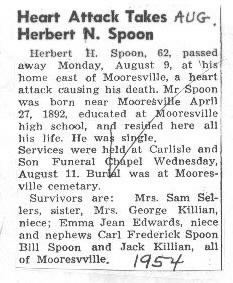
Herbert Spoon (1892-1954), who was a livelong Mooresville resident.
Celebrating Paul Hadley & the Indiana State Flag Centennial, by MPL
(Peggy Killian Benson's presentation begins at the 26:44 mark)
Herbert Spoon's Obituary
(Mooresville Times, August 12, 1954)
The
1920 U.S. Census states that Herbert Spoon lived on a farm "east of the
Vandallia Railroad," and Peggy Killian Benson remembers the cabin
sitting near White Lick Creek. If we look at the 1920 Plat Map of Brown
Township, Morgan County, Indiana, we can see the probable location of
the Spoon cabin portrayed in Paul Hadley's painting.
Excerpts from the 1920 U.S. Census including Herbert Spoon
1920 Plat Map of Brown Township, Morgan County, Indiana
(Probable Location of the Spoon Cabin in Red)
What does
this area look like today? Paul Hadley painted another picture near
Spoon's cabin, according to Peggy Killian Benson. This was called "East
Fork of White Lick Creek" and is on display at the library.
"East Fork of White Lick Creek," by Paul Hadley
Modern Map of Area Near Spoon Cabin
Aerial Views of Area
Modern Photo of East Fork of White Lick Creek
(Near Spoon Cabin Site)
Spoon's Cabin Was Near Today's Rooker Trace & Rooker Run Subdivisions
Peggy
Killian Benson's living memory of the Spoon cabin site should be
dispositive of its true location. There were, however, many Spoons
living in and around Mooresville during the 19th and 20th centuries, and
perhaps it would be fun to talk a little about some of them. Using the
U.S. Censuses from 1870-1920, along with genealogical information from
our Spoon family vertical file (in the MPL Indiana Room)
dating to the 1830's, we found a longtime Spoon homestead at 142 East
Harrison Street, at which Spoon family members resided continuously for
at least 75 years. The house is listed by exact address in the 1920 census, when Alonzo and Etta May Spoon lived at 142 East Harrison Street.
1920 U.S. Census for Mooresville, Brown Township, Morgan County, Indiana shows Alonzo and Etta M. Spoon living at 142 E. Harrison St. (the 1870-1880 censuses listed Alonzo's grandfather, Peter Spoon, residing there)
In the 1880 census, Alonzo Spoon was age 14 and lived on High Street with his parents, Mitchel (spelled Mitchell in
the censuses) and Tempy Staley Spoon. However, Mitchel's father, Peter
Spoon, who was Alonzo's grandfather, lived at 142 East Harrison Street,
according to the 1870 & 1880 censuses.
1880 Census showing Peter Spoon, Alonzo's Grandfather,
When
Alonzo's grandfather, Peter Spoon, died in 1888, the house remained in
the family (going to Peter's son, Mitchel, who was Alonzo's father). Alonzo
and Etta May Spoon were married on September 14, 1892, when they moved
into 142 East Harrison Street (possibly a wedding present from Mitchel
& Tempy?). Alonzo and Etta May lived there until their deaths (1937
and 1946, respectively).
Alonzo Spoon obituary
(Mooresville Times, December 30, 1937)
Etta May Spoon obituary card
MPL Indiana Room obituary files
Peter Spoon and his descendants lived at 142 East Harrison Street continuously between at least 1870 and 1946.
Unfortunately, Hadley could have spared us all this speculation and historical research if he had simply named his painting "William Spoon's or Herbert Spoon's (or Alonzo Spoon's, or, even, Peter Spoon's) cabin,"
but the artist probably wasn't imagining that anyone would be writing about it 75 years after the
fact. But, still.
How do things look at 142 East Harrison Street recently (say, these 2014 photos below)?
Next, let's consider the unlikely possibility that the painting actually portrayed "the Robb cabin" (especially improbable, given the testimony of Peggy Killian Benson). That will take us south to Centerton, Indiana (still in Morgan County, though). Let's see the painting again to refresh our memories (and save us scrolling up a lot).
Quoting
(again) from Hardin's biography of Paul Hadley (emphasis added):
"This painting ["Cabin"] was presented to the Mooresville Library by
the Tri Kappa Sorority. A newspaper story says it is 'The Robb Cabin' [. . . .]" [Hardin, Becky, The Indiana State Flag: Its Designer (Biography of Paul Hadley with Anthology of his Paintings), p. 16-17 (1976). Click here to find links to read a digital copy of this fine biography.]
Around
these parts, "the Robb Cabin" would most likely refer to John Robb.
Once again, Becky Hardin provides us with the historical details
(quoting John Robb's great-great-grandson, Harold Scott):
"'John Robb lived at the foot of the hills just west of Centerton [in
Morgan County, Indiana, about eight miles south of Mooresville]. He
had taken out a patent of land on Oct. 30, 1834. He moved in among a
group of early settlers and soon became one of the community's leading
citizens. He had more education than most and became the scribe for his
neighbors. In addition, he acted as a local lawyer in settling estates
and was usually referred to as "Squire." [. . . .] After building a
small home just west of Centerton, he opened a clay pit and manufactured
brick. The hills behind his house are now known as Robb Hills. He had
a large and active family, some of whom became merchants in
Centerton.'" [Hardin, Becky, ed.. Morgan County Scrapbook, Volume I (1985). Mooresville: Dickinson Publishing Co., p. 148.]
Where
were the federal land patents that John Robb secured when he settled
west of Centerton? He obtained two, in 1834 and 1838.
Land Patents to John Robb (1834, 1838) in Section 3 of
Township 12 North, Range 1 East (2nd PM),
Morgan County, Indiana
John Robb's land patents were near Center Valley (upper left corner, above the railroad tracks [where "Center Valley" is written on this map inset])
Map inset showing State Road 67 (dark road) and Milhon Drive running across John Robb's land
[Maps from Boyd, Gregory A. Family Maps of Morgan County, Indiana
Our trusty Morgan County road map shows Robb Hill and Milhon Drive plainly:
Map courtesy of the Morgan County
Economic Development Corporation
Here's what John Robb's land looks like today.
Robb Hill (looking west) at the intersection of Robb Hill Road & Milhon Drive John Robb's cabin was approximately where the house on the right is now standing
Paul Hadley's "Cabin" (again)
Was
Paul Hadley's painting actually portraying John Robb's cabin? You can clearly see woods
continuing for a considerable distance in the painting's background.
This suggests a more rustic setting than, say, inside the town of
Mooresville. The presence of chickens in the picture is
inconclusive--folks throughout Mooresville raised chickens in their
backyards during the 1930's, as did their country counterparts--but the
continuing trees certainly spell rural. But
trees, of course, are only one consideration. There's a much bigger
object missing from the painting. Where's Robb Hill? Or was Hadley
facing in another direction, so the hill wasn't in his background view?
In other words, was the hill behind him (or to his left) as he painted? Regarding town versus country, consider this description by Becky Hardin:
"Pictures
by Paul Hadley have historic value. [. . . .] His paintings depict a
way of life that will soon be gone. This old cabin, windowless at one
end with a chimney for fireplace is a type no longer built. A chicken
is free to wander about the dooryard which is framed by a board picket
fence. Notice the gable which turns back which is Greek Revival style."
[Hardin, The Indiana State Flag (1976), p. 16.]
Was
Hardin describing a country cabin or a town cabin? We already know
that Hardin believed Hadley's painting was the Spoon home, so,
certainly, she was thinking town, but I can't help but feel that, in the
above paragraph, she's describing a cabin couched in the countryside.
If so, then it could have been Robb's cabin, but it could just as
easily have belonged to the Spoon family or somebody else.
As
Hardin declared, Hadley's paintings have historic value. Watercolor
moments capturing a bygone era for us to enjoy now and in the future.