Showing posts with label state. Show all posts

Thursday, July 21, 2022

Cataract Falls (Following Paul Hadley's Footsteps)

On July 4, 2014, we travelled to Cataract Falls State Recreation Area on Mill Creek, in northern Owen County, Indiana (just south of Cloverdale).  The falls are just upstream of Cagles Mill Lake (Lieber State Recreation Area).


Click Images to Bigify

Click Map to See Original

We were retracing Paul Hadley's footsteps as we explored the places he painted roughly a century ago.  Our first stop was the upper falls, followed (wait for it . . .) by the lower falls.  Mr. Hadley captured both of these in watercolor, which are on display at Mooresville (Indiana) Public Library.

 Cataract Falls (Upper Falls)
by Paul Hadley


 Cataract Falls (Lower Falls)
by Paul Hadley


Although our photos are nowhere near as breathtaking as Mr. Hadley's paintings, let's compare them, just for fun.

 Cataract Falls (Upper Falls)

Cataract Falls (Lower Falls)

Mill Creek watershed looks considerably different than it did about a century ago, when Paul Hadley traversed the rugged countryside to paint the scenery.  In 1952, Cagle Hills Lake was built just downstream of the lower falls to become Indiana's first flood control reservoir.  It now comprises the Lieber State Recreation Area.

Photoshopped Cauli Le Chat at the bottom of the Upper Falls

 Looking down at the Upper Falls

 Just above the Upper Falls, looking downstream

Atop the Upper Falls, looking across stream
(We'll be over there shortly)

Owen County's last covered bridge sits immediately upstream of the Upper Falls.

 Cataract Falls Covered Bridge


  Resting a spell at the covered bridge

Picnic with a view

Looking downstream from the center
of the covered bridge

 Factoids about the covered bridge


We left the bridge to explore the river bank on the other side.  It was treacherous walking through the heavy underbrush, at least for some of us.

  Having a little difficulty blazing the trail

Who put that tree there?

 The Upper Falls from the other side

Other side downstream of the Upper Falls

On our way back to the car, we noticed an old water pump.  I don't think much water will be forthcoming any time soon.

Where's the pump handle?

Bob Dylan would tell us that "the pump don't work 'cause the vandals took the handles" ("Subterranean Homesick Blues" [1965]).

We next drove a short distance to the Lower Falls.

 The Lower Falls

 How'd those fishing folks get down there?

Looking downstream above the Lower Falls

  Closer to the edge than I'd be standing


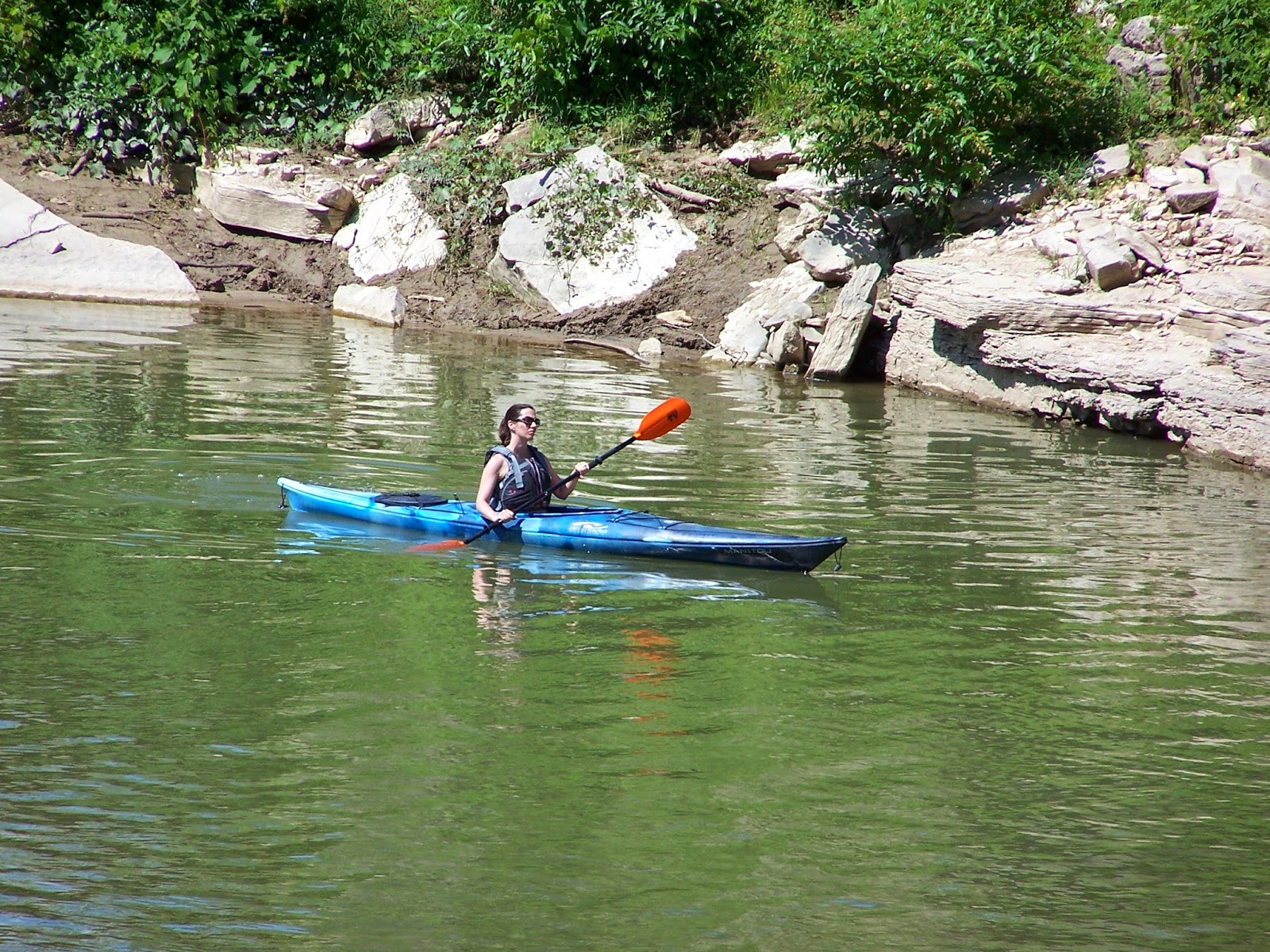
 Kayaking below the Lower Falls
(Well, not immediately underneath)

 "What are they biting on?"
"The end of my fishing line"

 
It was a really cool place to visit.  I can see why Mr. Hadley chose to paint this beautiful area. You should visit, too.
 

Thursday, January 25, 2018

Mooresville's Bicentennial Park: A Historical Perspective

Folks driving through downtown Mooresville have likely noticed the new Bicentennial Park located on the northeast corner of Main and Indiana Streets.

Mooresville Bicentennial Park (complete with traffic noise)
(December 5, 2017 video by the author)
(click video to play--it's in focus, really)


I've been asked a few times to explain the meaning of the sculpture.  I'm no art critic, but I'll have a go at interpretation.

Mooresville Bicentennial Park Sculpture
(December 5, 2017 photo by the author)
(Click pictures to enlarge)

The sculpture represents the flames atop the torch on the Indiana State Flag.

Indiana State Flag
(designed by Paul Hadley in 1916; adopted in 1917)

The town's motto is "Home of the [Indiana] State Flag," because Paul Hadley designed the flag, and spent much of his life, here.  So the sculpture commemorates that event.

From a historical perspective, the torch flame sculpture represents more than just the flag.  It symbolizes the eternal flame of human hope and progress, as demonstrated through one's hometown.  Mooresville's pioneers laid down roots here because they saw the potential of a bright, shining future, filled with prosperity, community spirit, social diversity, and the pursuit of happiness.  That future has been transpiring since 1824, and it continues to blossom, as the torch is passed from generation to generation of Mooresvillians.  The sculpture is an invitation to everyone living and working here to keep building upon what our forebearers created and established.  After all, future generations will look back upon us as part of their history, and we want to shine on brightly to them, as our predecessors shone.  We may now be facing 21st century challenges, but our pioneering spirit is the same as those who came before.

Bicentennial Park incorporates other aspects of Mooresville history, as we discussed previously in this blog.

Historical commemorations like Bicentennial Park are important because we need a sense of continuity, of belonging to something bigger than ourselves.  Each person who calls Mooresville home, whether in a residential or a business sense, contributes another brick in our historical edifice, which grows progressively taller and more majestic.  Bicentennial Park honors all of us by showing that the light of Mooresville cannot be extinguished--not by hard times or environmental disasters--so long as we are willing to make a stand to support our community.

Tuesday, December 5, 2017

Downtown Mooresville's New Bicentennial Park

Mooresville's new Bicentennial Park is now substantially completed and open to the public.  The park is downtown on the northeast corner of Main and Indiana Streets, where Samuel Moore's general store was situated (built in 1824), and where the Independent Order of Odd Fellows (I.O.O.F.) buildings were located (the first was built in 1869, replacing Moore's wood-frame/brick structure; the second in 1881).  The I.O.O.F. capstone (dated 1859) has been incorporated into the new park (see photo below).  (As always, click the images to enlarge them.)  The capstone commemorated the founding of I.O.O.F. Morgan Lodge #211 in 1859, NOT the date the first building was constructed, but the capstone was incorporated into the structure in 1869 when the first building was erected.


The park's sculpture reminds us of the flames atop the torch shown on the Indiana State Flag.


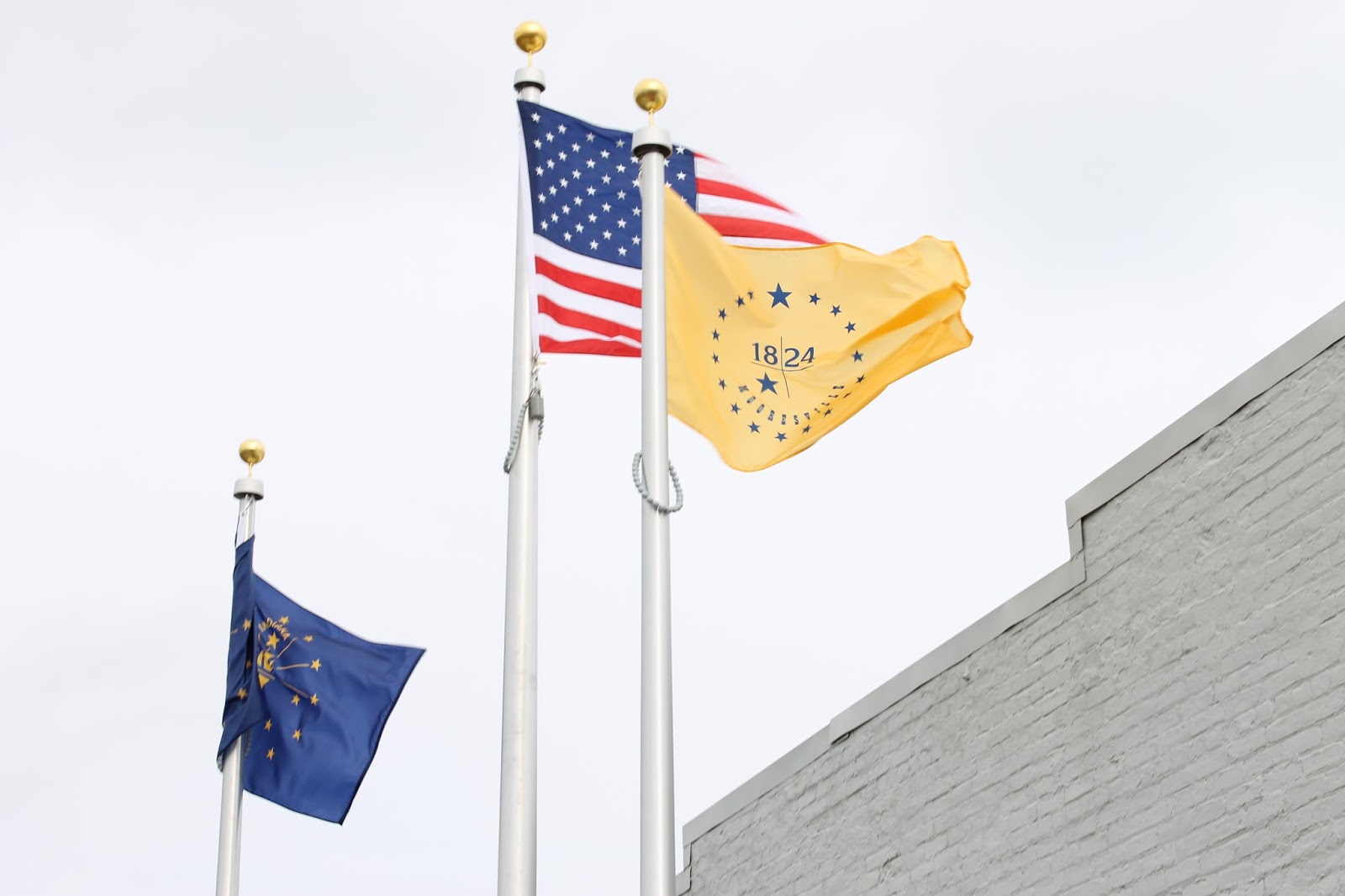
Alongside the American and Indiana flags flying in the park is Mooresville's official town banner, designed in 1974 as part of the town's sesquicentennial celebration by Bonita Marley (1906-2002), director of Mooresville Public Library (1961-1984).


The state historical marker commemorating Paul Hadley and the Indiana State Flag was relocated a few feet north of its original location.


Landscaping and final touches will be completed in Spring 2018, according to an article in the Mooresville-Decatur Times, Saturday, December 2, 2017, pages A1-A6.

New street lights, brick sidewalks, and signage surround downtown on Main and Indiana Streets, as can be seen in the photos above and below.


Monday, March 13, 2017

Indiana's First Female State Legislator Was a Mooresvillian

Did you know that the first woman to serve in the Indiana General Assembly was born and raised in Mooresville, Indiana?

Julia D. Nelson (née Julietta Reynolds)
(1863-1936)
First Female in the Hoosier State Legislature

Click the Video (Above) to Learn More


Born in Mooresville on December 11, 1863, Julietta ("Julia") Reynolds attended the Mooresville Academy School until 1880, when she married Edward F. Nelson.  The couple moved to Indianapolis circa 1887.  Subsequently, in 1903 Julia and Edward moved to Muncie, Indiana, where Edward was employed as a pressman for the local newspaper.    (Pressmen operated the printing presses; not to be confused with a reporter.)  Julia served as chairwoman of the Delaware County Republican Women's Club during the 1920 elections.  She was also active in the women's suffrage movement, as well as organizations such as the Order of the Eastern Star and the State Assembly Women's Club.

Following the death of state representative J. Clark McKinley just before the November, 1920 election, Julia D. Nelson was selected as McKinley's replacement to represent Delaware County in the Indiana House.  Julia served one full term (1921-1923).  Her first speech before the General Assembly called for legislation for the care and support of poor parents by their children.  During her first year in office, she introduced five resolutions, of which the most notable were:

  • House Bill 425:  To establish private hearings in criminal cases involving rape and in determination of paternity hearings.
  • House Bill 322:  To establish an Indiana Motion Picture Board to examine, approve, and regulate movies shown in Indiana theaters.
In 1932, following Edward's death, Julia moved back to Indianapolis.  She died on May 27, 1936 and is buried in Crown Hill Cemetery.

Many thanks to the Indiana Commission for Women for information about Julia D. Nelson.

Saturday, January 28, 2017

Indiana Bicentennial Torch Relay DVD

The Indiana Bicentennial Torch Relay DVD is now available to checkout from our Evergreen Indiana catalog.

Click Image Above to Enlarge

The video recounts the events between September 9 to October 15, 2016, "when the Indiana Office of Tourism Development held a 3,200-mile torch relay through all 92 Indiana counties. Carried by over 2,200 Hoosier torchbearers, the torch began the journey in Corydon and concluded in Indianapolis during the Indiana Bicentennial Commission's Hoosier homecoming celebration. This documentary serves to commemorate the event for all future Hoosier generations."  (DVD insert, back cover.)

Look for the DVD (there are two copies) in our media alcove.  Maybe "Flat" Dovydas Balčiūnas will be there to help (click photo below to enlarge).