Showing posts with label painting. Show all posts

Thursday, July 21, 2022

Cataract Falls (Following Paul Hadley's Footsteps)

On July 4, 2014, we travelled to Cataract Falls State Recreation Area on Mill Creek, in northern Owen County, Indiana (just south of Cloverdale).  The falls are just upstream of Cagles Mill Lake (Lieber State Recreation Area).


Click Images to Bigify

Click Map to See Original

We were retracing Paul Hadley's footsteps as we explored the places he painted roughly a century ago.  Our first stop was the upper falls, followed (wait for it . . .) by the lower falls.  Mr. Hadley captured both of these in watercolor, which are on display at Mooresville (Indiana) Public Library.

 Cataract Falls (Upper Falls)
by Paul Hadley


 Cataract Falls (Lower Falls)
by Paul Hadley


Although our photos are nowhere near as breathtaking as Mr. Hadley's paintings, let's compare them, just for fun.

 Cataract Falls (Upper Falls)

Cataract Falls (Lower Falls)

Mill Creek watershed looks considerably different than it did about a century ago, when Paul Hadley traversed the rugged countryside to paint the scenery.  In 1952, Cagle Hills Lake was built just downstream of the lower falls to become Indiana's first flood control reservoir.  It now comprises the Lieber State Recreation Area.

Photoshopped Cauli Le Chat at the bottom of the Upper Falls

 Looking down at the Upper Falls

 Just above the Upper Falls, looking downstream

Atop the Upper Falls, looking across stream
(We'll be over there shortly)

Owen County's last covered bridge sits immediately upstream of the Upper Falls.

 Cataract Falls Covered Bridge


  Resting a spell at the covered bridge

Picnic with a view

Looking downstream from the center
of the covered bridge

 Factoids about the covered bridge


We left the bridge to explore the river bank on the other side.  It was treacherous walking through the heavy underbrush, at least for some of us.

  Having a little difficulty blazing the trail

Who put that tree there?

 The Upper Falls from the other side

Other side downstream of the Upper Falls

On our way back to the car, we noticed an old water pump.  I don't think much water will be forthcoming any time soon.

Where's the pump handle?

Bob Dylan would tell us that "the pump don't work 'cause the vandals took the handles" ("Subterranean Homesick Blues" [1965]).

We next drove a short distance to the Lower Falls.

 The Lower Falls

 How'd those fishing folks get down there?

Looking downstream above the Lower Falls

  Closer to the edge than I'd be standing


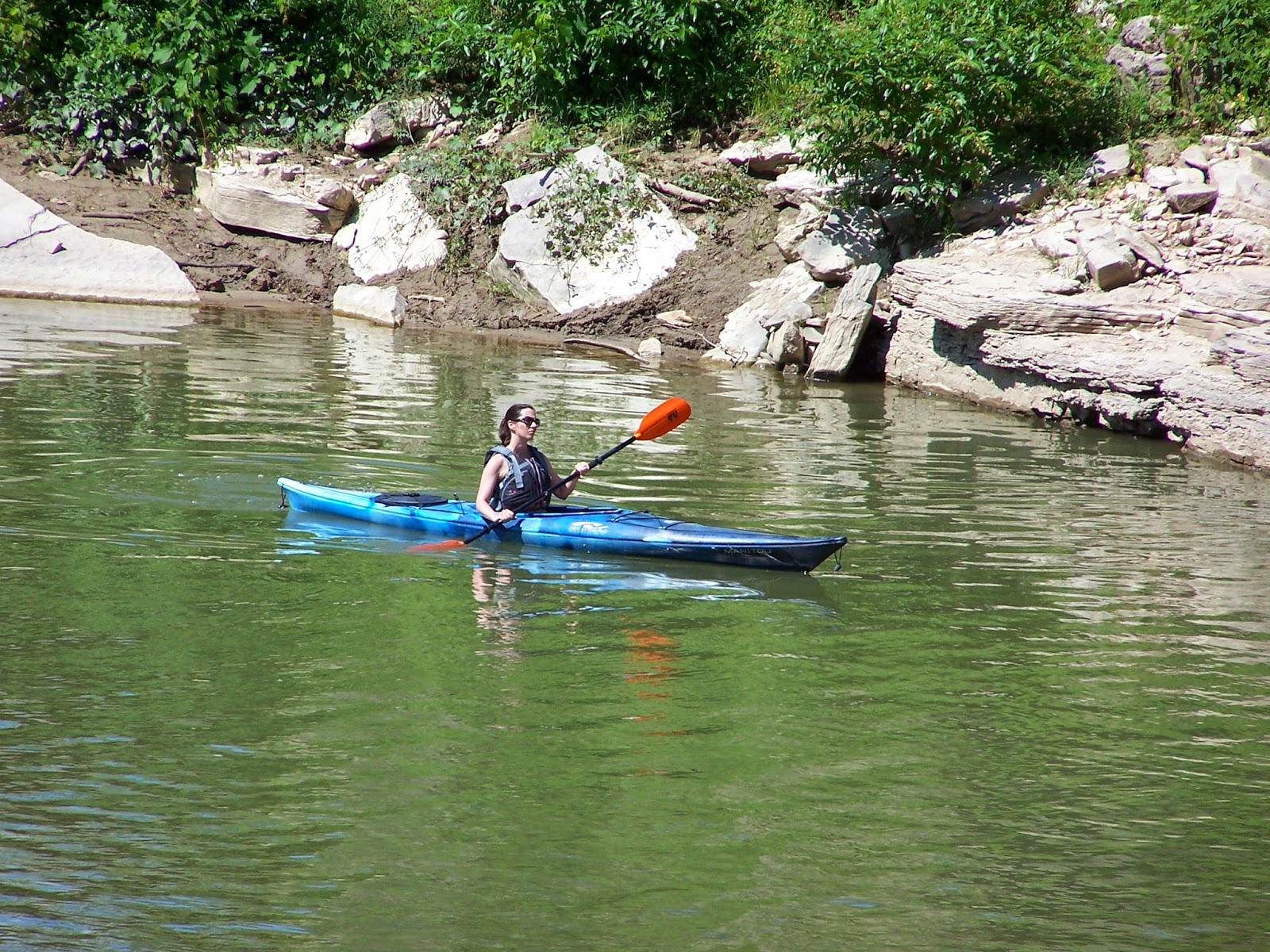
 Kayaking below the Lower Falls
(Well, not immediately underneath)

 "What are they biting on?"
"The end of my fishing line"

 
It was a really cool place to visit.  I can see why Mr. Hadley chose to paint this beautiful area. You should visit, too.
 

Brooklyn Covered Bridge (Following Paul Hadley's Footsteps)

Once again, we're walking in the footsteps of longtime Mooresville resident Paul Hadley (1880-1971), who designed the Indiana State Flag and was a well-known impressionist watercolor artist who taught students at the Herron Art Institute in Indianapolis.

In the summer of 2014, we visited the Brooklyn Bridge.

Not That One!

Let's begin by showing Paul Hadley's painting of the covered bridge that once stood in Brooklyn, Indiana, which is displayed at Mooresville (Indiana) Public Library.  Click the photos to enlarge.


Compare painting with this 1911 photo of
the Brooklyn mill, dam, & covered bridge
[courtesy of Stuttgen, Joanne Raetz & Tomak, Curtis.
Morgan County (Postcard History Series) (2007).
Charleston, SC: Arcadia Publishing, p. 87]

Hadley painted the bridge (well, more precisely, his painting OF the bridge) nearly a century ago--but probably after Brooklyn Mill was demolished in 1924 (see photo above).  The covered bridge is no longer there (neither are the dam or mill), but now there's a concrete bridge (constructed in 1948) in approximately the same spot crossing White Lick Creek at Brooklyn's edge.  You can tell by the terrain that this was the correct bridge location--plus we know the road leading into (and out of) town historically crossed the river thereabouts on the way to Brooklyn cemetery (further southward).  Plus we have that 1911 photo above (and historical caption), which pretty well nails the thing down tight.

Brooklyn Bridge Today

  Janet Buckley (Head of Technical Services at
standing upstream of the modern bridge
looking downstream (south)
along White Lick Creek

Observant readers will have noted that Hadley must have been standing downstream of the covered bridge near the eastern bank of White Lick Creek (looking north at the west end of the covered bridge). He was probably painting approximately where that fishing person is standing in our above photo (look left beneath the bridge).  Hadley might possibly have stood in the river's shallow waters to capture the perspective.

Upstream (north) view of White Lick Creek
(the modern bridge is behind photographer)

Watch out for traffic across the bridge!

Photoshopped Cauli Le Chat (with "Flat" Cauli) & Janet Buckley

 
The concrete bridge is certainly utilitarian, but it lacks the grace of its wooden ancestor Hadley so elegantly captured in his watercolor painting. White Lick Creek, too, looked more charming with those rocks and that little waterfall.

When I first saw Hadley's painting at the Library, I mistakenly thought it was the red covered bridge that, a century ago, spanned the East Fork of White Lick Creek on the Waverly Road (now State Road 144) at Mooresville's outskirts.  Upon closer inspection, however, it's obviously not that bridge in Hadley's painting.  See what you think.

Brooklyn's covered bridge was quite charming.  I'm glad we know its beauty, thanks to Paul Hadley.


Smokehouses (Following Paul Hadley's Footsteps)

Another Paul Hadley watercolor painting on display at Mooresville (Indiana) Public Library is "Smokehouse."  (Click here to learn more about Mooresville's favorite son.)


Click images to enlarge


Where was this smokehouse?  There must have been a gazillion smokehouses scattered around Mooresville and vicinity during Hadley's lifetime, and this one was no exception.  He probably painted it during the 1920's, and it likely appeared at his 1924 or 1931 exhibitions at Herron Art Institute in Indianapolis, where Hadley taught art during this period.

We've reviewed dozens of old local photographs, taken by longtime residents and professional photographers J. P. Calvert (1842-1917) and Manley Brown (1894-1968) (among other photographers), but we didn't see any smokehouses resembling Hadley's painting.


Jarvis P. Calvert (1842-1917)


Methodist Episcopal (M.E.) Church, Mooresville (1914)
(photo by J. P. Calvert)

Both Brown and Calvert climbed atop the Methodist Episcopal (M.E.) Church steeple (at the corner of South Indiana and East Harrison Streets in downtown Mooresville) to take panoramic photos of the town as it looked during the late 1880's-early 1890's and circa 1910 (Calvert) and in 1920 (Brown). That is WAAAAAAY up in the air--much too high for me.  Here's what they saw.

 J. P. Calvert's photo atop the M.E. Church steeple
looking southeast (late 1880's-early 1890's)


J. P. Calvert's photo atop the M.E. Church steeple
looking northeast (late 1880's-early 1890's)


J. P. Calvert's photo atop the M.E. Church steeple
looking northwest (late 1880's-early 1890's)


J. P. Calvert's photo atop the M.E. Church steeple
looking west (along West Harrison Street) (ca. 1910);
 MPL now stands at the end of the street on the right


 Manly Brown looking west along West Harrison Street
atop the M.E. Church steeple (1920)


 Manly Brown looking southeast along East Harrison Street
atop the M.E. Church steeple (1920)


Manly Brown looking north along South Indiana Street
toward the center of downtown Mooresville
atop the M.E. Church steeple (1920)


 Manly Brown looking south along South Indiana Street
atop the M.E. Church steeple (1920);
The Village Shopping Center now stands in the
open fields beyond the trees (upper right)

There were several small structures that resembled smokehouses (and, for that matter, outhouses, or privies) in these photos, but I saw nothing that looked like Paul Hadley's painting.  Maybe we should try our sense of smell.  Good way to differentiate smokehouses from outhouses.  Sadly, you can't smell what appears in old photos.  (The pictures themselves don't smell so great, either.)

Some of my younger readers may not know what use was made of smokehouses. Through the 1930's (and even later), there were in-town residents who, like their country cousins, raised livestock. Many had barns and outbuildings in their backyards to house these animals.  Pork was cured (preserved) by smoke in smokehouses.

So, as far as Hadley's "Smokehouse" painting hanging at the Library, we have absolutely no idea where it was located.  But wait!  Hadley painted other smokehouses, and we know where they were.  Does that count?


"Full Bloom," by Paul Hadley (1942)
(Click image to enlarge)

[Excerpted from Hardin, Becky, The Indiana State Flag: Its Designer (Biography of Paul Hadley with Anthology of his Paintings), p. 28 (1976).  Click here to find links to read a digital copy of this fine biography.]

In 1942, Omri Schooley lived in the smokehouse at 154 West Harrison Street. That's less than a block east of the Library.  Let's take a quick hike down the street and see how things look there now.


154 West Harrison Street Today


The smokehouse was at the back of the property.  In Hadley's "Full Bloom" painting, you can see the fence row and an outbuilding to the left.  You can see those today in the photo below.


The smokehouse in "Full Bloom" was situated
at the closer fence corner (in front of the white
object and automobile).  The wooden outbuilding
on the left (in the painting) is where the
tan, concrete block structure now stands
 
 
Another Hadley painting captured a white smokehouse at the Samuel Moore Rooker house, constructed in 1877 and located at 30 West Harrison Street. Rooker was the first European-descended child born in Mooresville after the town was founded, so he was named after the founder, Samuel Moore.  Rooker's granddaughter, Helen (York) Cook, and her husband, Claire Cook, lived there for decades.  

Newspaper Article About the Cook/Rooker Home
by Becky Hardin, Morgan County Historian
[Hardin, Becky, ed.  Morgan County Scrapbook, Volume I (1985).
Mooresville: Dickinson Publishing Co., p. 285.]
(Click images to enlarge)


Cook/Rooker House (2009)


The smokehouse was located behind the home, as you can just barely see in the digital scan below.  The original image of this painting (used in Hardin's book) was very faint.
 

"White Smokehouse," by Paul Hadley
and smokehouse shown attached to the
Rooker/Cook residence (1976)

[Excerpted from Hardin, Becky, The Indiana State Flag: Its Designer
(Biography of Paul Hadley with Anthology of his Paintings), p. 30 (1976).


Let's see what the smokehouse attachment looks like today, shall we?
 

Rooker/Cook smokehouse was located
inside the now-screened-in porch area
on the back of the house

Paul Hadley must have been fascinated with smokehouses as watercolor subjects--or perhaps they were plentiful within comfortable walking distance.  Hadley didn't drive motor vehicles, so he either had to walk around town to paint subjects or have his friends drive him to suitable landscape painting destinations.