Showing posts sorted by date for query "Bonita Marley". Sort by relevance Show all posts

Sunday, March 5, 2023

The Historical Journey Never Ends


Indiana Room at Mooresville Public Library

Just Before the Dedication of the New Addition

(January 26, 2006)

(Last updated:  January 9, 2025).

In March, 2010, during a meeting at Mooresville (Indiana) Public Library, one of my colleagues, Suzanne Walker, who was then the library's youth services director, was discussing a social media initiative with the library's executive director, Diane Huerkamp, and me.  The library had already launched its YouTube channel; we could add Facebook, Twitter, and something called "Blogger," whatever that was, which featured "blogs," whatever they were.  Suzanne envisioned expanding the library's "global footprint" through its use of social media.  We could disseminate our messages far and wide to many more people than merely those who entered through the library's doors.

Suzanne already used Blogger to recommend children's and teen books to read and, along with other staff, was about to create new blogs focusing upon the library's youth services programs.  Blogs could also be used for adult services content.  She suggested I write a blog about the history of Mooresville, Indiana.

Would people read a local history blog, I wondered?  With an Internet already overloaded with trivial, over-personalized content, could an audience be attracted discussing the past of a town with fewer than 15,000 residents?  I doubted it, but I was game to try.

So, on April 3, 2010, I "published" my first "post" to this "blog."  Re-reading it now, the tone reminds me of a standup comic whose tired old material is bombing but who doesn't want to surrender the stage in humiliating defeat.  Of course, I was just starting this journey, so I didn't know exactly where I was going or how I planned to get there.  Maybe I should cut my former self some slack.

Thirteen years later, I've reached the end of my library career.  I've written a few hundred blog posts here, as well as over a thousand elsewhere (on four other blogs, two of which are long gone from the web, but two of which are still around here and here).  As of January, 2025, I've reached over 400,000 views with this local history blog; I reached another million views on my other blogs, and over 2.77 million views on the library's YouTube channel.  Suzanne's social media initiative was a success beyond our wildest expectations.

As my retirement date approaches (May 6, 2023), I look back fondly upon the historical tales we've shared here.  Looking back is what historians do; since I've been portraying one at the library for the past 16 years, I wanted to stay in character until my last day, when I will close the library's Indiana Room (and, as manager-in-charge, the library) for what will be my final time.

This blog will remain online until such time as Google (or whoever will control the Blogger site) decides otherwise.  Links to PDFs will remain active until Mooresville Public Library updates to new website servers.  This blog has been a rewarding experience that, with any luck, was somewhat informative and, perhaps, mildly entertaining.  I'm grateful for the support I've received from the library board and the library's executive director (Diane Huerkamp, who retired at the end of December, 2024).  Not many employers would have tolerated my spending endless hours turning out this tripe.  They always had encouraging words for my efforts.  I appreciate that.

There's much local history to be found on these blog posts.  If you've enjoyed it, thank one of my predecessors, Wanda Potts (MPL Indiana Room librarian, 1966-2002, and assistant director from the 1970s to the 1990s) for creating and maintaining the historical collections from which I've drawn everything.  Also thank Bonita Marley (MPL executive director 1961-1984), who preserved all the local history filed before Wanda came aboard (and handed it over to Wanda to preserve thereafter).  Myrtle Keller (MPL staffer & assistant director during the 1960s and 1970s) also contributed to the library's historical collections, as did each of the library directors and staff before Mrs. Marley.  My immediate predecessor, Marylou Smith, also deserves kudos for her fine work preserving Mooresville's past.  None of the material I've presented here (or elsewhere) regarding local history would have been possible without their tremendous efforts to organize and safeguard it.  All I did was type and upload some images.

Finally, thank YOU for reading about Mooresville's past.  Local history collections are diminishing in public libraries these days, so having an interested audience has helped Mooresville Public Library continue its mission to protect the past for the future to explore.  I hope the library's Indiana Room resources will be around for many years to come.  History continues forward, so there will always be something new and fresh to discover.  The historical journey never ends.


Tuesday, July 7, 2020

A 130-Year-Old Landmark in Downtown Mooresville

One of the many tragedies of the tornado that devastated downtown Mooresville, Indiana on April 8, 2020, was the second-story collapse of the Bass Building, constructed circa 1890 on the southeast corner of the intersection of Main and Indiana Streets. (Click images to enlarge.)


The Bass Building at 3 East Main Street
after the 4/8/2020 tornado
(photograph © 2020 by Andy Hendricks)


Structural Support to the Bass Building (July 2020)
(photograph & video by William R. Buckley)

George W. Bass (1842-1924) was a Civil War veteran who moved to Mooresville in 1878. Around 1880 Bass built a single-story, wood-frame building to house his drugstore. We have a photo from about the time Bass opened for business. which shows the original structure, which was "a one-story, Greek Revival, gable-front frame building with Doric columns supporting a portico over the sidewalk," according to architectural historian Joanne Raetz Stuttgen.


(Circa 1880 photograph by J. P. Calvert,
donated to Mooresville Public Library
by Bonita Marley, October 23, 1968)

  (Circa 1885 photograph by J. P. Calvert showing East Main Street--Bass Drugstore is on the right)
 
 George W. Bass' house in Mooresville
(circa 1880 photograph by J. P. Calvert)

Around 1890, George Bass decided to upgrade his wooden structure, replacing it with a two-story brick building that has served the community for 130 years.  It was one of the oldest structures in downtown Mooresville.

The South side of East Main Street in downtown Mooresville
(Bass Drugstore is on the corner) 
(circa 1910 postcard photograph by J. P. Calvert)


1931 Photograph shows the Bass Building (far right)
when it housed Citizens Bank
(courtesy of Citizens Bank)


The Bass Building as it appeared in October 2007
(Photograph by William R. Buckley)

Compare the 1885 picture (below) with the 1920 picture (further below) to see the difference between the single-story and two-story buildings.  Both photos were taken from atop the Methodist Episcopal (M.E.) Church steeple, facing north.  Local photographers J. P. Calvert and Manley Brown took the 1885 and 1920 photos, respectively.


(1885 J. P. Calvert photograph courtesy of the
 Mooresville Times, August 8, 1974)

(Photograph by Manly Brown, 1920)

Let's add a couple of arrows to make the comparison easier.


The second floor consisted of a stage and large meeting room, which was used for town hall meetings, plays and musicals.  It was commonly called the "Mooresville opera house" around the turn of the 20th century.

The basement was the location for many businesses, including a barbershop (1890s-1920), and, most recently, a video store (2000s).

The first floor of the building was divided into two halves, which housed:

  • West half:
    • Bass Drugstore (1890-1920)
    • First National Bank (1920-1927)
    • Mooresville State Bank (1927-1930)
  •  East half:
    • Burch Grocery (1890s-1920)
    • George Allison's Grocery (1920-1927)
 

Burch Grocery occupied the east half of
the Bass Building.  Burch used horse-drawn wagons
to delivery groceries
(circa 1908 photograph by J. P. Calvert)

Burch sold out to George Allison in 1920.
Allison operated his grocery there until 1927,
when he moved to South Indiana Street
(circa 1920 photography by Manley Brown)

Interior of George Allison's grocery
(George is standing on the right)
in the east half of the Bass Building
(early 1920s photograph)


In 1931, the separating wall was removed, allowing the entire first floor to be used by Citizens Bank, which operated in the Bass Building until 1966, when it was replaced by a clothing store (into the 1970s).


1931 Photograph shows the Bass Building (far right)
when it housed Citizens Bank
(courtesy of Citizens Bank)

(Below) Advertisements from the 1955-1968
Wagon Trails, Mooresville High School's yearbook


Those last three advertisements show Citizens Bank at its current location on the east side of North Indiana Street downtown.

The Bass Building has been an important part of Mooresville history for well over a century.  Restoration was not possible, but at least we can honor its place in our hometown community story.

UPDATE FALL 2022:  The Bass Building was demolished in September and October, 2022.  Learn more from this blog post.


Tuesday, August 21, 2018

Is Mooresville Public Library Haunted?

During the summer of 2012, professional paranormal investigators discovered some strange happenings throughout the building. The group (Hoosier Ghost Investigators [HGI]) encountered spontaneous psychokinetic (PK) activity, electronic voice phenomena (EVP), anomalous sounds, electromagnetic (EM) disturbances, and sudden temperature changes.

We've got a handout that explains HGI's paranormal discoveries along with a map showing locations of such activities. Click the links below to see the handout or watch our videos:


Ghostly Hoosier Haunts Episodes 4-6:  Library Haunting


Considerable paranormal activity occurred in the library basement. EM interference appeared to disrupt a flashlight's beam without mechanically altering the on/off switch. (The flashlight was fully functional and otherwise operated perfectly.) The team captured some video using somebody's cell phone (to view, click these hyperlinks:  005, 006, 007; or click the video players below).


The flashlight's flickering appeared to answer "yes" and "no" questions posed by the investigators.  Two alleged communicating entities identified themselves.  One claimed to be the grandmother of one of the participants, and another claimed to be a former Mooresville library director.  Some identifying information was provided.  While some of the EM flashlight interference seemed intelligently driven, more experiments would need to be conducted to replicate these results if they are to be more than simply suggestive of paranormality.
 
There was audible knocking on tables and walls throughout the building without anyone present causing the noises. Apparently, EVP was recorded on the team’s audio devices—voices that could be heard on playback that were not heard while the recordings were being made (i.e., in addition to conversations recorded of people present, there were voices recorded saying things that nobody present had said), and there was nothing previously recorded on the devices that could have “bled” through.  The spontaneous PK movement in the Indiana Room, when a book moved by itself from a tightly-packed bookshelf to land five feet away on the floor, was impressive. Was any of this done by disembodied spirits? There is insufficient evidence from which to draw a conclusion, but, certainly, something paranormal appeared to be happening.

Paranormal Activities in 2013-2014:  The MPL maintenance staff have observed strange phenomena at night after the library has closed.  These include: (1) computers spontaneously turning themselves on and off, without any ordinary explanation (i.e., the computers had no automatic command settings to turn on or off, and no one present activated them)--these computers stayed on only long enough to display an image of a woman dressed in black; (2) a woman's voice singing from mid-air in the Grand Hall, when nobody (other than maintenance staff) was physically present in the building, and no electronic devices were operating that could play a recording or receive a radio, television, or Internet transmission; (3) doors opening and closing by themselves; and (4) objects placed in one location mysteriously appearing in other locations without being moved by anyone present.

Most recently (December 1, 2014), the library's youth services page saw a little girl (age approximately 10 years) near the youth biography section of the youth services department.  The girl was wearing an old-fashioned jumper (based upon the page's description, it was of the type worn over 50 years ago).  The girl was sitting on the floor.  The page informed her that she would need to move to a table nearby, as floor-sitting was not allowed (for safety reasons). The girl did not speak but stared intently at the page.  The page then wheeled her book cart to the youth services information desk, and, upon looking back to see if the girl had moved, the page was surprised to see that the girl was gone. The page looked throughout the youth services area, but the girl was not found.  To have exited youth services, the girl would have had to have walked directly in front of the YS information desk. Neither library staff nor patrons in the area saw the girl leave.  "It was as if she just disappeared," said the page.

Let's move from psychical science to folklore. Haunted places as folklore become part of a society's legendary collective storytelling. As stories passing through the cultural consciousness, they are interesting without the need for veridical evidence. As such, we may speculate freely about possible causes. Some of the purportedly spiritualistic communications secured in the library basement appeared to come from disembodied entities identifying themselves as former MPL director Bonita Marley (1906-2002) and Mooresville school teacher and librarian Marian Adams (1920-2000). Although this has not been verified as genuine spiritual interchange (from a parapsychological standpoint), it makes for great folklore stories.

Visit the Library to see if anything paranormal happens to you. Anything's possible. If you're interested in paranormal books, watch our book trailer playlists. We've got one for nonfiction and another for fiction.

To learn more about the paranormal, please visit The Psi Encyclopedia.

Sunday, December 17, 2017

New Local History Video Series

Mooresville Public Library has begun a new video series (see playlist) called Mooresville Moments: Our Local History, based upon its collection of local history postcards and flashcards.  The title is borrowed from the popular newspaper column, "Mooresville Moments" (1999), written by town historian Wanda Potts (1921-2012), who served as MPL's Indiana Room librarian from 1966 to 2002.

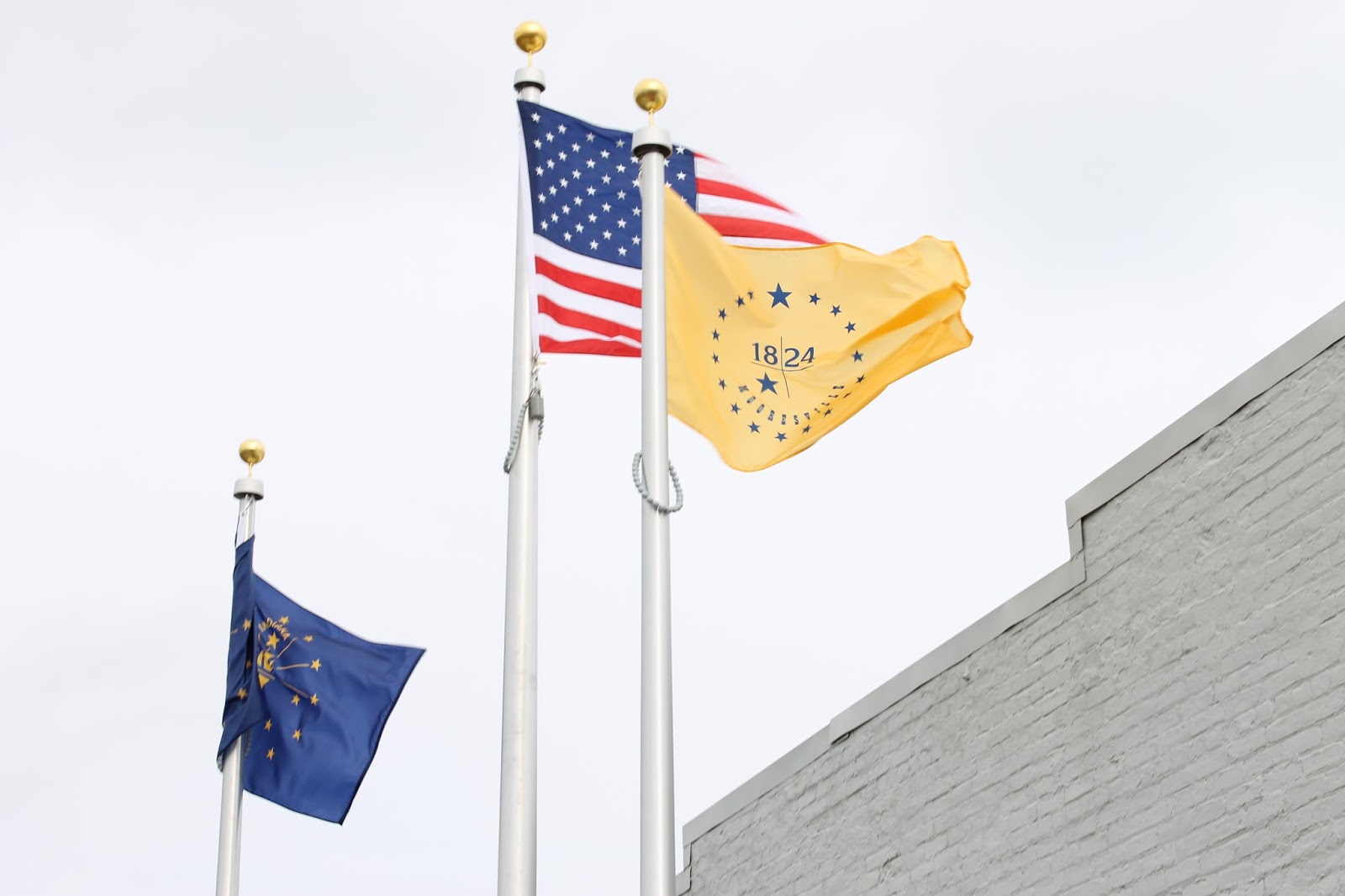
In this first installment, we feature the official Mooresville Town Banner, designed by Bonita Marley, who served as library director from 1961 to 1984. The flag commemorated the 150th anniversary of the town's founding. You can see it flying downtown in Bicentennial Park.

Mooresville's Town Banner (video)
(Mooresville Moments #1)
by Mooresville Public Library

Thanks to Wanda and Bonita, the library has an extensive local history collection preserved to share with the public. We hope this new video series does justice to their treasure trove of Mooresville history.

Tuesday, December 5, 2017

Downtown Mooresville's New Bicentennial Park

Mooresville's new Bicentennial Park is now substantially completed and open to the public.  The park is downtown on the northeast corner of Main and Indiana Streets, where Samuel Moore's general store was situated (built in 1824), and where the Independent Order of Odd Fellows (I.O.O.F.) buildings were located (the first was built in 1869, replacing Moore's wood-frame/brick structure; the second in 1881).  The I.O.O.F. capstone (dated 1859) has been incorporated into the new park (see photo below).  (As always, click the images to enlarge them.)  The capstone commemorated the founding of I.O.O.F. Morgan Lodge #211 in 1859, NOT the date the first building was constructed, but the capstone was incorporated into the structure in 1869 when the first building was erected.


The park's sculpture reminds us of the flames atop the torch shown on the Indiana State Flag.


Alongside the American and Indiana flags flying in the park is Mooresville's official town banner, designed in 1974 as part of the town's sesquicentennial celebration by Bonita Marley (1906-2002), director of Mooresville Public Library (1961-1984).


The state historical marker commemorating Paul Hadley and the Indiana State Flag was relocated a few feet north of its original location.


Landscaping and final touches will be completed in Spring 2018, according to an article in the Mooresville-Decatur Times, Saturday, December 2, 2017, pages A1-A6.

New street lights, brick sidewalks, and signage surround downtown on Main and Indiana Streets, as can be seen in the photos above and below.


Saturday, August 6, 2016

Paul Hadley/Indiana State Flag Historical Marker Dedication

The Paul Hadley/Indiana State Flag historical marker dedication ceremony was held this morning (Saturday, August 6, 2016) in downtown Mooresville, Indiana.  Here are a few photos from the event.  Click the photos below to enlarge.


The new historical marker awaiting its unveiling


Dave Nash, chairperson, Celebrate Mooresville,
welcomes the audience


Casey Pfeiffer, historical marker program manager, Indiana Historical Bureau,
spoke about the public process used to establish historical markers
(and this marker particularly)


Dave Nash spoke about honoring Paul Hadley


Lois Huntington, State Regent, Indiana Daughters of the American Revolution,
spoke about the Indiana State Flag's legacy

 Bud Swisher, Healthier Morgan County, spoke about
personal memories of Paul Hadley and
designing the Indiana State Flag

  
Janice Bolinger, Honorary State Regent,
Indiana Daughters of the American Revolution,
spoke about the meaning of the Indiana State Flag's symbols
and the historical mysteries surrounding the flag


The unveiling!


The new historical marker!


The front side of the new historical marker


The rear side of the new historical marker

At the beginning of the ceremony, Mooresville Boy Scout Troop 231 honor color guard presented the colors--first, the American flag, then the Hoosier flag.


Also on display at the dedication ceremony was the official Mooresville town banner, designed in 1974 by MPL director Bonita Marley.  The town flag is on permanent display in the MPL Indiana Room.


A nice crowd was on hand for the dedication. The marker is located in Hadley Memorial Park in downtown Mooresville (on the northeast corner of the intersection of Main and Indiana Streets). The marker site was also the location of Samuel Moore's general mercantile store, which was the first wood-frame business built in Mooresville (Moore founded the town in 1824).


MPL treasurer Steve Saucerman speaks with
Mooresville Academy museum director/historian Julie Kyle-Lee

 MPL president Lynn Adams (right)

Learn more about the history of the Indiana State Flag and Paul Hadley at: 

  • Poletika, Nicole.  "'A Permanent Emblem of Its Own:'  The Indiana State Flag & Its Designer."   Indiana History Blog, January 11, 2017.  Indiana Historical Bureau of the Indiana State Library.  (Click here to access the blog article.)