Showing posts sorted by relevance for query "bicentennial park". Sort by date Show all posts

Saturday, January 27, 2018

The Return of the Native (Founder Stone)

Mooresville's "Founder Stone" has returned downtown to Bicentennial Park, as reported in today's edition of the Mooresville-Decatur Times.


Mooresville Bicentennial Park & the
new location of the "Founder Stone"
(January 27, 2018 photos by the author)
(click photos to enlarge)

According to Times reporter Anthony Woodside, the founder stone has been placed at the back of the park closer to Citizens Bank's parking lot.  Originally, the stone (and affixed plaque) were situated on the northeast corner of Indiana and Main Streets closer to the intersection.


The "Founder Stone" at its original location
Northeast corner of Indiana & Main Streets
Downtown Mooresville
(October 29, 2007 photo by the author)


As we mentioned in a previous blog post, the stone and plaque were removed last year during construction of Bicentennial Park and had been stored in the town's highway department garage.

The founder stone (and plaque) were originally placed downtown as part of Mooresville's centennial celebration (in 1924).  The project was directed by Samuel Moore's granddaughter, Mary Ida Fogleman, to celebrate the town's founding and her grandfather's first wood-frame business built on the site in 1824.

Samuel Moore's Plat of Mooresville
(1824, recorded February 21, 1825)


There has been some talk around town (with which I personally agree) that the stone should have been returned closer to the front of the property, where it had originally sat for decades. That precise location is most historically accurate, since Moore's business building was situated at the front of the lot.  A commemorative marker should be placed as close to the actual historical site as possible to correctly document what the marker is memorializing.  In any event, that's where the town (and Miss Ida) intended the founder stone to rest when they placed it in 1924.

At least the stone's new location is on land Moore owned.  Samuel Moore originally owned all of the land upon which Bicentennial Park (and Citizens Bank) stand--in fact, he owned all the land originally platted for the town in 1824.

Originally, the stone and plaque were placed close to the intersection because pedestrian traffic would best see it at the front of the lot.  Putting it in the rear area of Bicentennial Park is probably intended to encourage folks to saunter through the park and leisurely absorb the historical components.  History is best absorbed at a strolls-pace.  Whether or not people will actually do the walking and see the stone and plaque--that's another thing altogether.  When it was in front, it was easily visible to both walkers and drivers from the Main/Indiana Street intersection.  So front clearly reaches a larger audience.


I'm pleased to see the "Founder Stone" return to its native turf, even if the new location is not historically ideal.  Local historical markers are essential reminders of a community's past accomplishments.  That history offers current residents a common heritage, which has a unifying effect upon townspeople.  Regardless of our diversity (and that diversity should be honored, too), we share in common the town's past stories.  We should be proud of them, because we're living our own historical tales here right now, which future residents will look back upon with (hopefully) approval (or at least bemused curiosity).  We are a direct continuation of Mooresville's collective historical experience.  As the town's bicentennial approaches (2024), Bicentennial Park (and the founder stone) remind us that our community's greatness is measured by what has been, what is now, and what will be.

Thursday, January 25, 2018

Mooresville's Bicentennial Park: A Historical Perspective

Folks driving through downtown Mooresville have likely noticed the new Bicentennial Park located on the northeast corner of Main and Indiana Streets.

Mooresville Bicentennial Park (complete with traffic noise)
(December 5, 2017 video by the author)
(click video to play--it's in focus, really)


I've been asked a few times to explain the meaning of the sculpture.  I'm no art critic, but I'll have a go at interpretation.

Mooresville Bicentennial Park Sculpture
(December 5, 2017 photo by the author)
(Click pictures to enlarge)

The sculpture represents the flames atop the torch on the Indiana State Flag.

Indiana State Flag
(designed by Paul Hadley in 1916; adopted in 1917)

The town's motto is "Home of the [Indiana] State Flag," because Paul Hadley designed the flag, and spent much of his life, here.  So the sculpture commemorates that event.

From a historical perspective, the torch flame sculpture represents more than just the flag.  It symbolizes the eternal flame of human hope and progress, as demonstrated through one's hometown.  Mooresville's pioneers laid down roots here because they saw the potential of a bright, shining future, filled with prosperity, community spirit, social diversity, and the pursuit of happiness.  That future has been transpiring since 1824, and it continues to blossom, as the torch is passed from generation to generation of Mooresvillians.  The sculpture is an invitation to everyone living and working here to keep building upon what our forebearers created and established.  After all, future generations will look back upon us as part of their history, and we want to shine on brightly to them, as our predecessors shone.  We may now be facing 21st century challenges, but our pioneering spirit is the same as those who came before.

Bicentennial Park incorporates other aspects of Mooresville history, as we discussed previously in this blog.

Historical commemorations like Bicentennial Park are important because we need a sense of continuity, of belonging to something bigger than ourselves.  Each person who calls Mooresville home, whether in a residential or a business sense, contributes another brick in our historical edifice, which grows progressively taller and more majestic.  Bicentennial Park honors all of us by showing that the light of Mooresville cannot be extinguished--not by hard times or environmental disasters--so long as we are willing to make a stand to support our community.

Thursday, October 19, 2017

Restoring Downtown History

The Mooresville Redevelopment Commission (RDC) has restored a vital aspect of Mooresville's history downtown and plans to restore further historical tributes to this consequential site.

In Mooresville's Bicentennial Park, currently under construction downtown on the northeast corner of Main and Indiana Streets, the RDC has incorporated into a side wall the capstone of the Independent Order of Odd Fellows (I.O.O.F.) buildings, which memorialized the organization's founding of local Morgan Lodge #211 on July 7, 1859.  The I.O.O.F. buildings stood on this site from 1869 to 1989.  The first, three-story structure (built in 1869) was destroyed by fire in 1881, but was replaced by a second building (1881) that was partially demolished in 1964, with the remnant of the first floor finally being removed in 1989.  (The capstone had been stored in the Mooresville Academy School on Monroe Street for many years.)  The I.O.O.F. buildings housed generations of local family businesses.


I.O.O.F. Buildings Capstone
(courtesy of the Mooresville-Decatur Times)
(click photos to enlarge)


Second I.O.O.F. Building (ca. 1885)
(Photo by J. P. Calvert)


Second I.O.O.F. Building (July 18, 1920)
(Photo by Manley Brown)


Remnant of the First Floor of the Second I.O.O.F.
Building, Demolished in April, 1989
(Photo by Jack Broyer)

Recently, the "Founder Stone," a historical commemorative plaque affixed to a boulder honoring Samuel Moore (1799-1889), founder of Mooresville, was removed during construction of the new park.  Before the I.O.O.F. buildings, this was the site of Samuel Moore's first wood-frame business building (the first of its kind in Mooresville, built in 1824).  In 1989 plans were made to convert the property into a small park commemorating Paul Hadley (1880-1971), designer of the Indiana State Flag.  That park is now becoming Bicentennial Park.

The "Founder Stone"
(Photo by Shawn Stewart, February, 1998)


Janet (Griffin) Buckley with the "Founder Stone"
(October 29, 2007)
(Photo by William R. Buckley)

In addition to the "Founder Stone" and the I.O.O.F. capstone, the northeast corner of Main and Indiana Streets was the site of an official state historical marker honoring the state flag and its designer.  This marker, too, has been removed during construction but will be relocated on-site when the project is completed.


Paul Hadley/Indiana State Flag Historical Marker
(Dedicated August 6, 2016)
(Photos by William R. Buckley)


The citizens of Mooresville placed the Samuel Moore stone and plaque downtown in 1924 as part of the town's centennial celebration.  Samuel and Eliza Moore's granddaughter, Mary Ida Fogleman, was instrumental in the creation and placement of this historical tribute.

Samuel & Eliza Moore with their daughter,
Margaret Fogleman, and their granddaughter,
(Mary) Ida Fogleman (from A Brief History of the
First Methodist Church in Mooresville, Indiana [1950])

According to reporter Lauren Carpenter, "the RDC [Mooresville Redevelopment Commission] also plans to place the Samuel Moore plaque at the corner of the park as well. [. . .]  As of right now, there are no plans on where to place the stone."  ("Odd Fellows Sign Restored," Mooresville-Decatur Times, Saturday, October 21, 2017, page A6.)

This is indeed good news.  Restoration of the "Founder plaque" to its original location preserves important historical information about the origins of the town and its early pioneer days.  It is fitting that the new bicentennial park, which is designed to commemorate Mooresville's 200th anniversary in 2024, should be situated in such a significant historical location.  As to the stone itself, that's not nearly as important--it's just a boulder left in the glacial moraine that was salvaged from a nearby field--but the plaque is historically critical.

Small communities such as Mooresville need to preserve a sense of history--of continuity--connecting current residents with their predecessors.  Those who live here now stand upon the shoulders of all those who came before, including the town's progenitor.  Without Samuel Moore, there would have been no Mooresville that so many of us now call home.

Saluting Samuel Moore at the site of his first wood-frame business, as the "Founder plaque" has done for nearly a century, emphasizes the significance of the place and what has stood there.  When Samuel Moore built that wood-frame structure for his general store among the handful of surrounding log cabins, he was saying that Mooresville would become an established town, lasting long into the future.  The wood-frame business was unlike other places where log cabins were temporary abodes later abandoned.  It was at the center--the very heart--of the community Moore had established, and he wanted everyone to see that this town would endure.  And so it has, for nearly 200 years.

Original Plat of Mooresville, Indiana (1824)
(Recorded February 21, 1825, Morgan County Recorder)

What better way to honor the pioneer who created our hometown, and all the pioneers and settlers who came thereafter, than by the "Founder plaque" placed at the core of our community?  The plaque belongs on the northeast corner of Indiana and Main Streets downtown, and I salute the Mooresville RDC in its plan to restore it to its central location so that it may continue its part in our town's historical narrative.

Having the I.O.O.F. capstone in the new bicentennial park is likewise crucial to preserving Mooresville's downtown heritage.  Once the State Flag/Paul Hadley marker is also restored, we will have strong reminders of the importance of Mooresville's past in the development of it present (and future). 

Monday, December 18, 2017

Northeast Corner Changes

In 1824, Samuel Moore constructed his general store on the northeast corner of the intersection of Indiana and Main Streets in downtown Mooresville.  Let's see how that corner has changed over the years.

Situated on the northeast corner were the following:

  • Samuel Moore's general store (1824-1869);
  • First I.O.O.F. building (1869-1881);
  • Second I.O.O.F. building (1881-1989);
  • Paul Hadley memorial park (1990-2017);
  • Mooresville Bicentennial Park (2017-    )
Let's see some images, courtesy of the Indiana Room at Mooresville Public Library.

Original Plat of Mooresville, Indiana (1824)
(showing the northeast corner of Indiana and Main Streets)
(Section B4, Lots 1-2 & 15-16)
(Recorded February 21, 1825, Morgan County Recorder's Office)

After the fire (July 8, 1881) that destroyed
the first I.O.O.F. building (photo by J. P. Calvert)
(photo donated to MPL by Ernest L. Hadley [1891-1972])

Back of 1881 photo
MPL photo report for 1881 picture


I.O.O.F. Morgan Lodge #211 members parade in front of
the second I.O.O.F. building (circa 1885)
(photo by J. P. Calvert)

Second I.O.O.F. building is in the upper center
of this photo (circa 1885) by J. P. Calvert

East Main Street (circa 1890)
(Second I.O.O.F. building is at front left)
(photo by J. P. Calvert)

Second I.O.O.F. building (July 18, 1920)
(photo by Manley Brown)

(second I.O.O.F. building in background)
from the Mooresville Times, January 22, 1976)

2-22-22 celebration
(original photograph by Manley Brown)

Demolition of Hundley building
(just east of the second I.O.O.F. building)
(Mooresville Times, October 24, 1963)

Removal of top floor of second I.O.O.F. building
(Mooresville Times, July 23, 1964)


The second I.O.O.F. building's demolition began in 1964, with the top floor being removed; the entire second floor was removed, leaving a first-floor "sliver" remaining, so that Citizens Bank could extend its new building's parking lot in 1965-66.  The article headline (above) declares the Odd Fellows building to be 105 years old (in 1964), but that's mistaken.  The second I.O.O.F. building (built 1881) was 83 years old in 1964.  Even if the reporter had been dating to the first I.O.O.F. building (built 1869, burned down in 1881), the age would only have been 95 years old.  The reporter's error arose from the I.O.O.F. capstone (dated 1859), which was installed atop the first Odd Fellows building in 1869, and subsequently placed upon the second Odd Fellows building in 1881.  The capstone commemorated the establishment of Mooresville's I.O.O.F. chapter (Morgan Lodge #211), which was founded on July 7, 1859.  The capstone was being removed during the 1964 upper-story dismantlement, and the reporter had incorrectly assumed that the capstone's 1859 date corresponded with the building's age.

After the Odd Fellows capstone was removed in 1964, it was housed at Citizens Bank for a number of years. Some time later, it was kept at the Academy School Museum on North Monroe Street.  Since 2017, the capstone has been part of a wall in Mooresville Bicentennial Park (on the site of the Odd Fellows buildings).

I.O.O.F. Capstone
Mooresville-Decatur Times
October 21, 2017


Last day of the second I.O.O.F. remnant (April, 1989)
(photo by Jack Broyer)

Planning Paul Hadley mini-park (1989)
(Mooresville Times, July 21, 1999)


Janet (Griffin) Buckley sits atop the
"founder's stone" in Paul Hadley mini-park
during Mooresville's Victorian Christmas
(December 3, 2011)
(photo by William R. Buckley)

State historical marker commemorating Paul Hadley
& the Indiana State Flag being unveiled
(August 6, 2016)
(photo by William R. Buckley)

Mooresville Bicentennial Park
(December 5, 2017)
(photo by William R. Buckley)


Tuesday, January 7, 2020

Founder Stone Back Where It Belongs

Sometime in late December, 2019, Mooresville's "Founder Stone" was returned to its rightful place on the northeast corner of Indiana and Main Streets downtown.  The stone had stood at this location from its placement in 1924 until 2017.

Mooresville-Decatur Times
Tuesday, December 31, 2019, page A1
Click Image Above to Enlarge, or
Click Here to See PDF


The Founder Stone was removed in 2017 during construction of Mooresville's Bicentennial Park, which had been the site of Paul Hadley Memorial Park, and, before that, of the I.O.O.F. building, and, before that, of town founder Samuel Moore's general store, built in 1824.  The Founder Stone was stored in the Mooresville Street Department's facilities until January, 2018, when it was relocated further northeast on what had once been Samuel Moore's residential lot, but was (in 2018) part of the northeast corner of Bicentennial Park, next to Citizens Bank's parking lot.


The Founder Stone's original (and, now restored) position is historically more appropriate, since it commemorates Samuel Moore's general store, the first wood-frame structure in Mooresville.  The building survived the Great Fire of 1842, which destroyed all of Mooresville except Samuel Moore's home and business, and the structure was replaced in 1869 by the first I.O.O.F. brick-and-masonry building.  The stone once again sits in front of what once had been Samuel Moore's foundational business in the heart of town.


If you have not visited Bicentennial Park and seen the Founder Stone, drop by one day when the weather is nice.  You will be standing at the very root of Mooresville's history.

Tuesday, December 5, 2017

Downtown Mooresville's New Bicentennial Park

Mooresville's new Bicentennial Park is now substantially completed and open to the public.  The park is downtown on the northeast corner of Main and Indiana Streets, where Samuel Moore's general store was situated (built in 1824), and where the Independent Order of Odd Fellows (I.O.O.F.) buildings were located (the first was built in 1869, replacing Moore's wood-frame/brick structure; the second in 1881).  The I.O.O.F. capstone (dated 1859) has been incorporated into the new park (see photo below).  (As always, click the images to enlarge them.)  The capstone commemorated the founding of I.O.O.F. Morgan Lodge #211 in 1859, NOT the date the first building was constructed, but the capstone was incorporated into the structure in 1869 when the first building was erected.


The park's sculpture reminds us of the flames atop the torch shown on the Indiana State Flag.


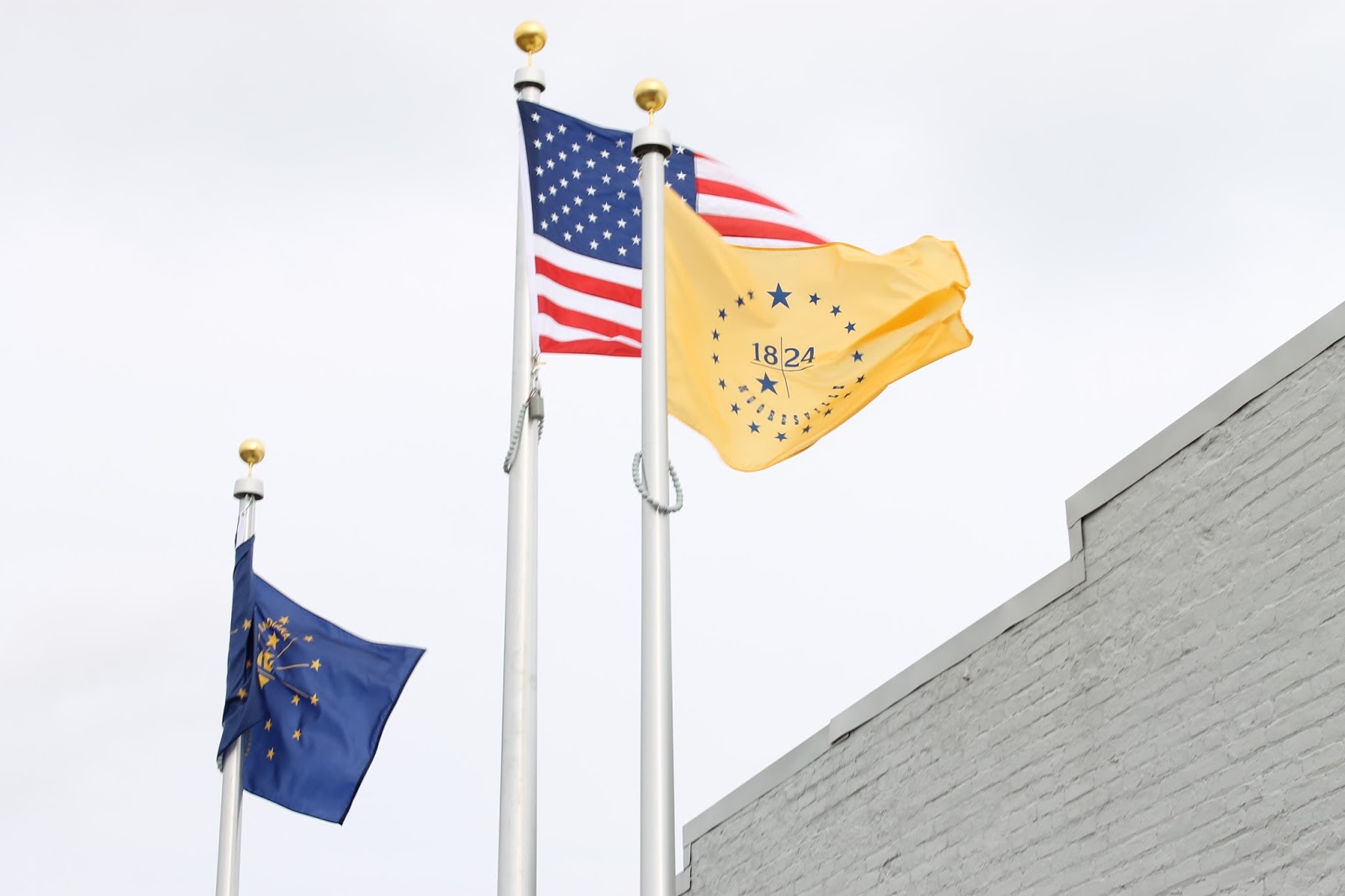
Alongside the American and Indiana flags flying in the park is Mooresville's official town banner, designed in 1974 as part of the town's sesquicentennial celebration by Bonita Marley (1906-2002), director of Mooresville Public Library (1961-1984).


The state historical marker commemorating Paul Hadley and the Indiana State Flag was relocated a few feet north of its original location.


Landscaping and final touches will be completed in Spring 2018, according to an article in the Mooresville-Decatur Times, Saturday, December 2, 2017, pages A1-A6.

New street lights, brick sidewalks, and signage surround downtown on Main and Indiana Streets, as can be seen in the photos above and below.


Thursday, May 14, 2015

Two-Twenty-Two-Twenty-Two


Click Photos to Enlarge


On February 22, 1922 (that's 2/22/22, at least in the U.S.), Mooresville High School students celebrated a basketball victory over Monrovia High School (24 points to 22 points) around the "silent policeman" pedestal (built by Raymond King) in the middle of the intersection of Main and Indiana Streets in downtown Mooresville, Indiana.  "Yell leaders" (what we now call cheerleaders) Delbert Wilson and Merle "Pinhead" Harvey stand atop the "silent policeman."

Note the horse carriage and the automobile, which were parked in separate areas "reserved" for horse-drawn vehicles (on North Indiana St.) and motor vehicles (on East Main St.) The I.O.O.F. building is in the background, where today (2015) stands Paul Hadley mini-park.  (UPDATE:  In 2017 the area became Mooresville Bicentennial Park.)

Note, too, that the "silent policeman" has been positioned incorrectly--it should have been turned 180 degrees to correctly designate directions to the cities listed. (The stand could be moved. This was a popular prank among high schoolers from neighboring communities. They would steal the "silent policeman" and haul it away somewhere, and Mooresville police would have to bring it back.)

 
"Two-Twenty-Two-Twenty-Two"
by Mooresville Public Library
(Mooresville Moments #27)